
At NoGLobalism.com we often enter areas of thought – and of discussion – which are foundational and which underlie much of today’s ongoings. We work mostly at the roots, for it is here, where the deepest and most profound understandings occur, and where change taken, affects all else thereafter.
In our previous newsletter “Setting Innovation to Zero”, which traced the rules-based order’s (RBO) paternalistic chokehold on innovation, along with its corollary issue “Globalism’s Spiritual Battle”; which exposed its deeper theology: a harmony creed that inverts the biblical dominion mandate into managed decline, promising peace while enthroning fear. Continuing along this line of inquiry, we now examine how this counterfeit gospel achieves such seamless infiltration, turning diverse societies into lockstep conformity without overt decrees?
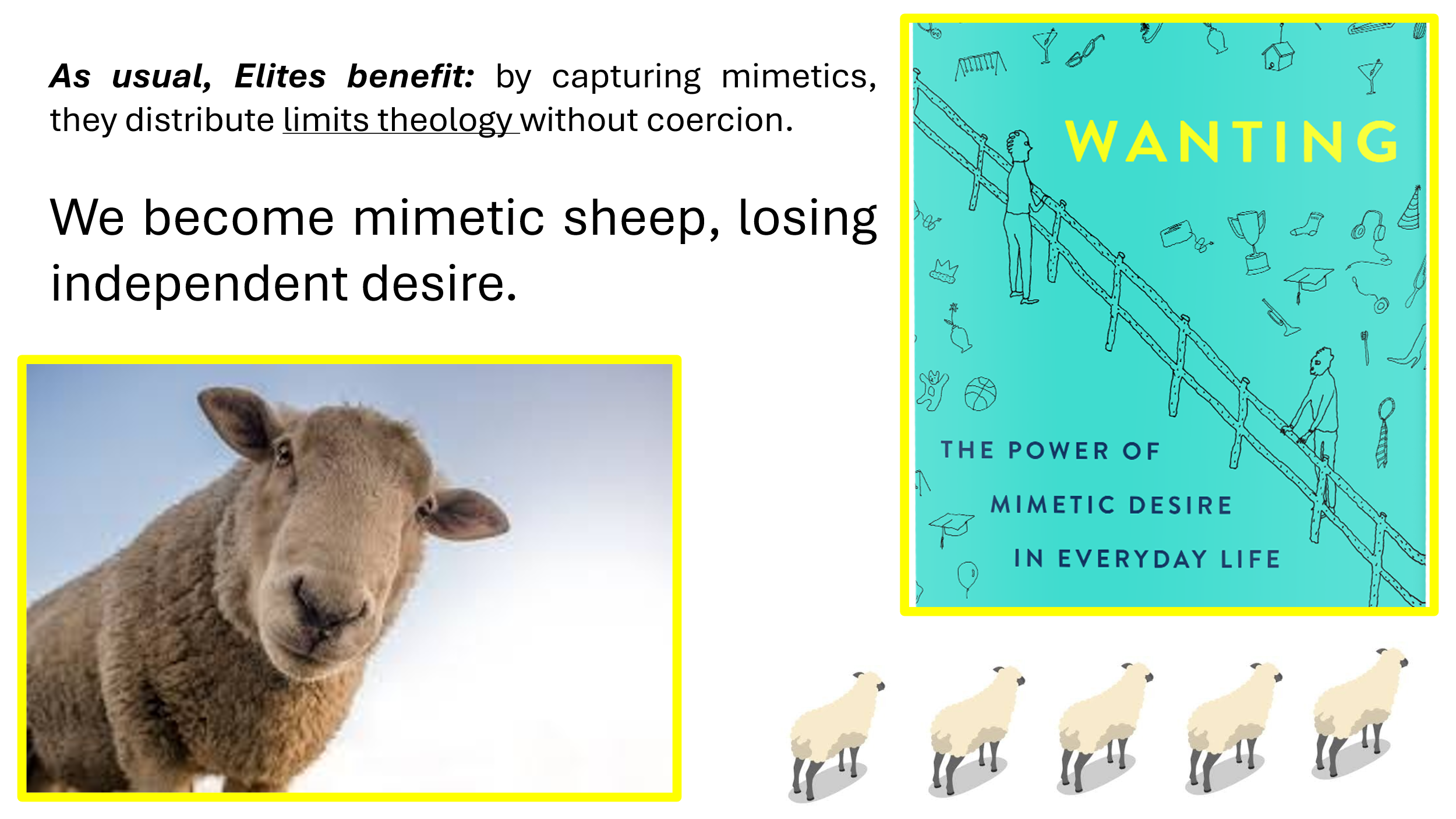
Think of how “Net Zero” morphed from fringe policy to global dogma in a decade, without a single worldwide vote or visible enforcer. The answer lies in René Girard’s mimetic theory: the viral imitation of desires that fuels rivalry, chaos, and false unity through scapegoating. Girard’s insight reveals mimetics as the hidden engine of the harmony creed; a mind virus elites capture to distribute their theology of limits.
As we explore mimetics, we’ll see why independent desire is the true battlefield, and how figures like Peter Thiel wield it to reclaim abundance.
The Foundations of Mimetic Theory: A Scientific Lens on Human Desire
Girard, drawing from literature, history, and anthropology, argued that desire is not innate or autonomous, it is mimetic. We borrow our wants from others (models). ¹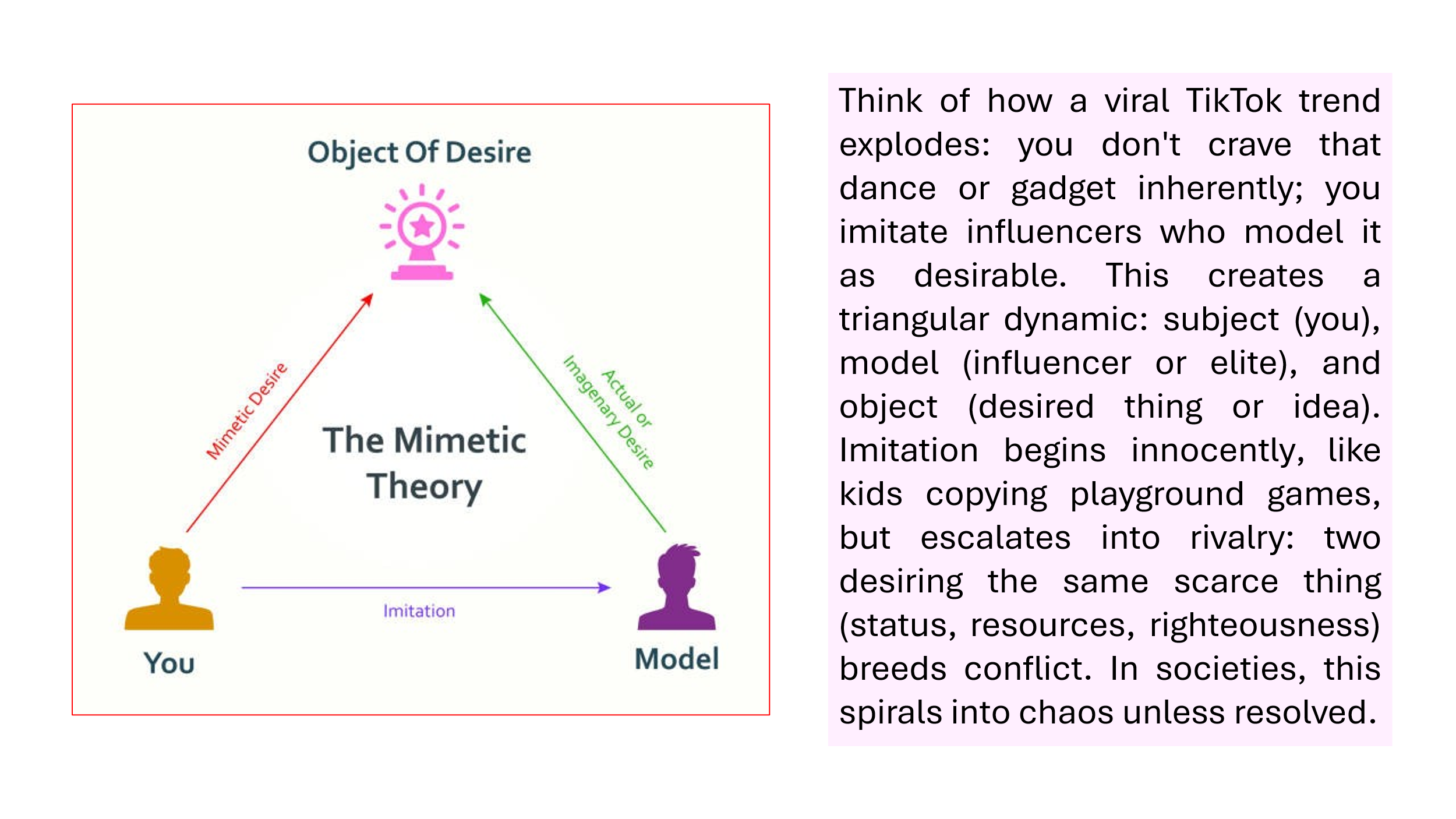
Girard identified the escape valve: the scapegoat mechanism. The group unites against an innocent victim blamed for the tension, sacrifices them (literally or symbolically), achieves catharsis, and restores false peace. Myths and rituals then sanitize the violence, hiding the victim’s innocence. ²
This aligns with observable science, explaining why elites can engineer consent without coercion. Mirror neurons fire when we observe others’ actions, fostering empathy but also envy and imitation, literally wiring our brains for contagion. ³ Social contagion studies show how trends, emotions, and moral panics spread through networks, not rational choice, turning personal desires into collective frenzy. ⁴
Mimetics in Today’s World: Political Correctness on Steroids
In our digital era, mimetics accelerates via algorithms that reward signals mimicking prestigious models (elites, influencers). A virtue starts with high-status voices, then millions imitate for approval or moral superiority. The desire isn’t justice; it’s emulating the model’s righteousness, sparking rivalry over who is “more compassionate” or “more aware.”
Immigration enforcement offers another stark example. Protests against ICE raids and deportations, sparked by events like the June 2025 Los Angeles mass deportation actions or the January 2026 shooting of Renee Good in Minneapolis, erupt with intense rage, framing agents as oppressors in a system of “cruelty.”⁶
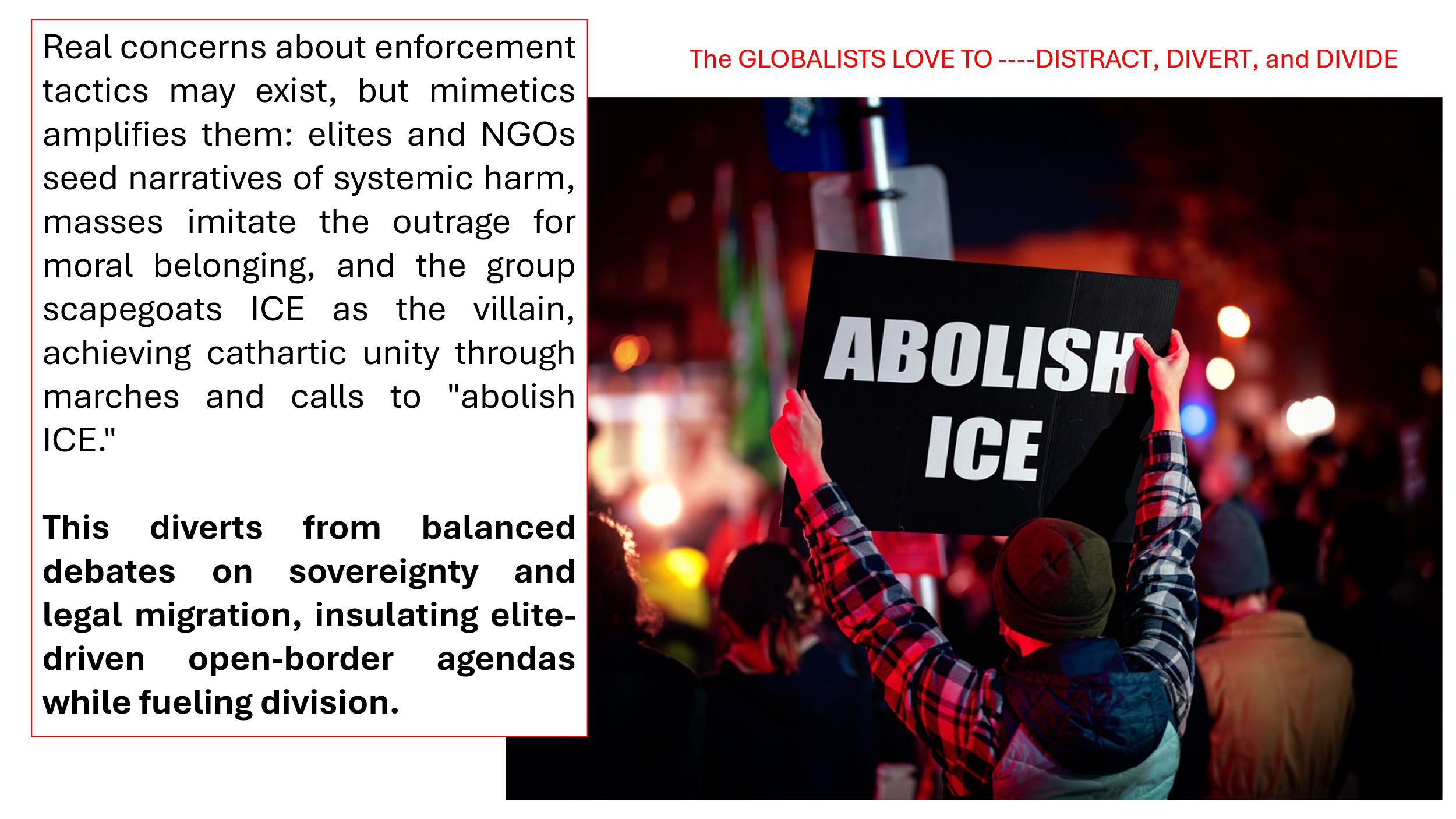
Frameworks drawing from cultural Marxism supercharge this by reframing tensions through oppression lenses: identify as oppressed, borrow the pre-identified oppressor (e.g., “privileged” classes or enforcement agencies), and channel desire toward blame for moral one-upmanship. ⁷ Real inequalities exist, but mimetics redirects energy from solutions to symbolic battles. The scapegoat is rarely the funding elites (e.g., billionaire-backed NGOs); it’s the symbolic “oppressor,” insulating power while providing false unity.
Cancel culture exemplifies this: mobs unite against a dissenter accused of “harm,” expulsion brings catharsis, but it’s the thrill of shared righteousness, not truth. “Safe spaces” ration discourse like the harmony creed rations the future. This is the antichrist spirit in digital form: counterfeit harmony through exclusion, as warned in 1 John 4:3, crying “peace and safety” while destruction looms (1 Thessalonians 5:3).
Christ as the Scapegoat: Exposing the Scheme
Girard’s deepest insight is that mimetics isn’t inevitable doom, it’s a scheme that can be exposed. And Christianity does exactly that through the figure of Christ, the ultimate innocent scapegoat whose death unmasks the mechanism for all time.
In the Gospels, Jesus becomes the focal point of mimetic rivalry: the Pharisees envy his influence, Pilate imitates the crowd’s demands to avoid unrest, the disciples scatter in fear. The crucifixion is the perfect scapegoating ritual, the mob cries “Crucify him!” to resolve their chaos, blaming Jesus for disrupting the order. But unlike archaic myths that hide the victim’s innocence, the New Testament proclaims it: Jesus is sinless, the Lamb of God slain for the world’s sins. His resurrection unmasks the lie; scapegoating brings no true peace; it’s violence built on deception. ⁸
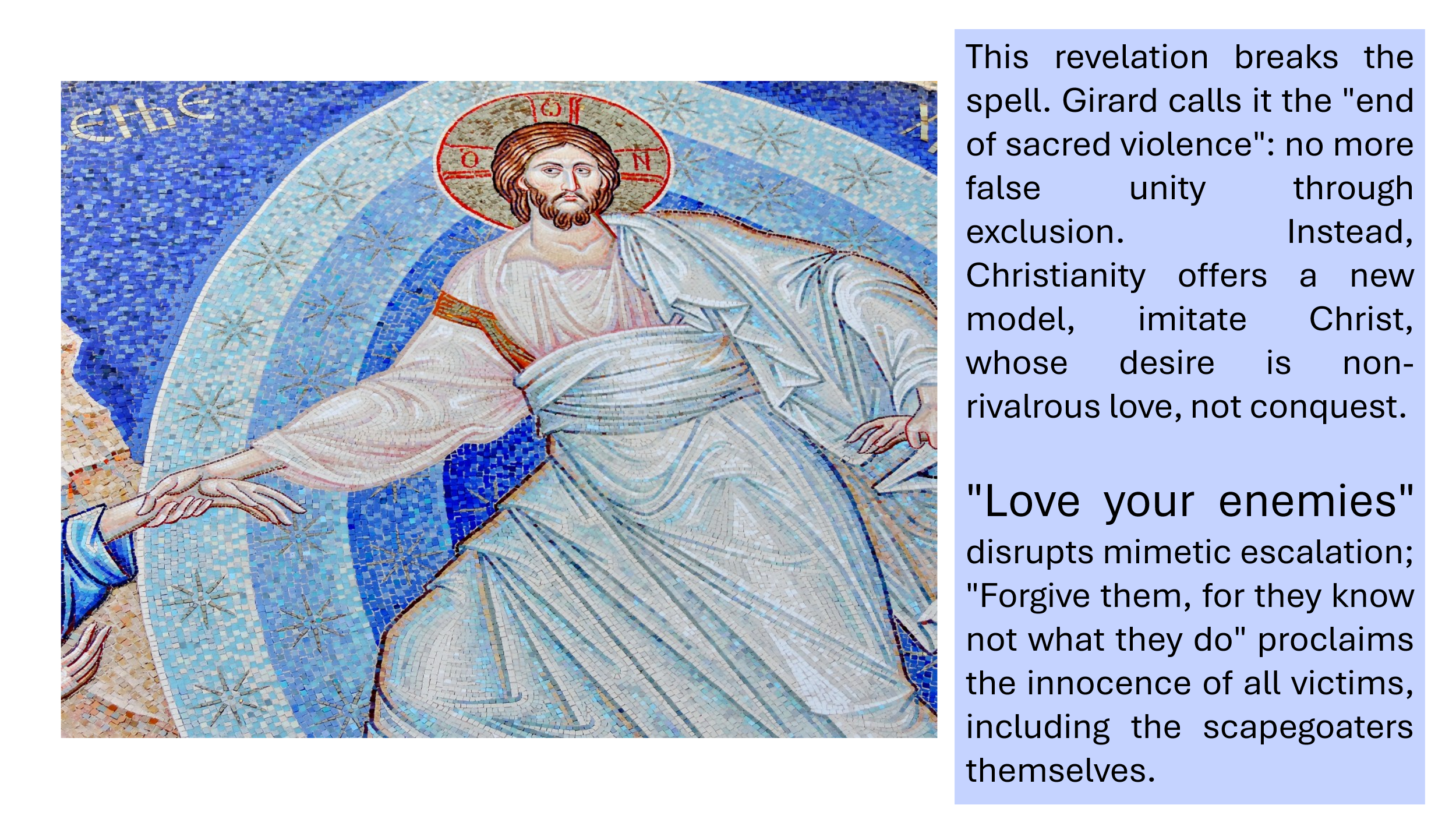
In our world, this exposure is revolutionary. The harmony creed’s false virtue, empathy as blame, precaution as control, relies on hidden scapegoating. Christianity unmasks it, calling us to true empathy: seeing elites and masses alike as trapped in mimetic desire, forgiving the cycle, and pursuing reconciliation.
Building Communities of True Compassion
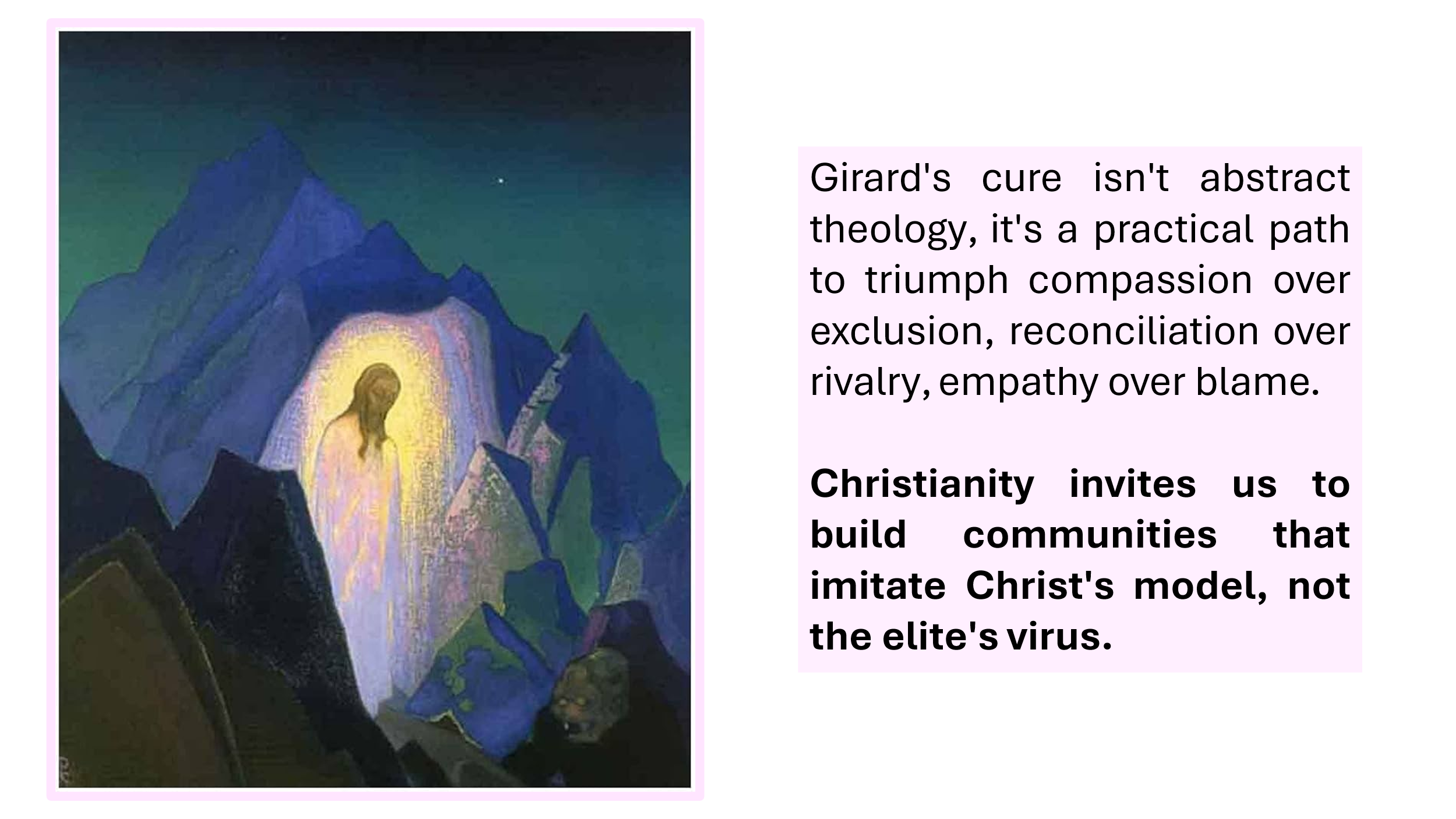
Compassion over Exclusion: Welcome the outsider, as Jesus did with lepers and sinners, rejecting scapegoating. In practice: churches and groups that foster diverse dialogue without purity tests, countering the harmony creed’s divisive “safety.”
Reconciliation over Rivalry: Forgive and seek common ground, breaking mimetic loops. But true reconciliation bears fruit: abundance. When communities imitate Christ’s non-rivalrous love, they stop competing for scarce moral status or resources. Instead, they create together, shared energy projects, innovation hubs, local prosperity, proving that dominion, not limits, is the path to flourishing. Abundance dilutes the mind virus; it shows that there is enough when desire is freed from imitation.
Empathy over Blame: See all as victims of the mechanism, elites trapped in hubris, masses in imitation. True empathy heals, not subjugates; it raises awareness of the mind virus, encouraging independent desire rooted in divine mandate.
The Modern Wielder of the Cure
Girard’s revelation lives in Peter Thiel, his student and intellectual heir. With one foot in globalist structures building control, Thiel fights to unplug us, championing innovation against limits. ⁹ But is he a hero of Humanity or new elite? In Future newsletters, we examine Thiel himself and his influence: the hinge figure in this battle for our spiritual imagination.
Endnotes
1. Girard, René. Things Hidden Since the Foundation of the World (1978/1987). Stanford University Press. (Primary exposition of mimetic desire.)
2. Girard, René. Violence and the Sacred (1972/1977). Johns Hopkins University Press. (Core on scapegoat mechanism.)
3. Rizzolatti, Giacomo, and Laila Craighero. “The Mirror-Neuron System.” Annual Review of Neuroscience 27 (2004): 169–192. https://doi.org/10.1146/annurev.neuro.27.070203.144230
4. Christakis, Nicholas A., and James H. Fowler. Connected: The Surprising Power of Our Social Networks and How They Shape Our Lives (2009). Little, Brown Spark. (On social contagion via networks.)
5. Coverage decline noted in analyses (e.g., Media and Climate Change Observatory tracking reduced mentions in major U.S. outlets amid 2025 deregulation); Thunberg’s pivot to Gaza solidarity widely reported (e.g., Freedom Flotilla involvement, Rome march with Albanese, November 2025).
6. Examples include June 2025 Los Angeles protests against mass deportations (Wikipedia: https://en.wikipedia.org/wiki/June_2025_Los_Angeles_protests_against_mass_deportation; CNN, ABC News coverage) and January 2026 nationwide actions following the Renee Good shooting in Minneapolis (NPR: https://www.npr.org/2026/01/10/nx-s1-5673229/ice-protests-minneapolis-portland-renee-good; Wikipedia: https: //en.wikipedia. org/wiki/ Killing_of_Renee_Good; Reuters, CNN reports).
7. Pluckrose, Helen, and James Lindsay. Cynical Theories: How Activist Scholarship Made Everything about Race, Gender, and Identity—and Why This Harms Everybody (2020). Pitchstone Publishing. (Critique of frameworks drawing from postmodern/critical theory roots.)
8. Girard’s synthesis in Things Hidden Since the Foundation of the World applies this directly to the Gospels.
9. Thiel frequently cites Girard as influence (e.g., interviews, essays); see compilations like Luke Burgis’s newsletter on Thiel’s Girard engagement.