
FULL DOUBLE FEATURE NEWSLETTER
NoGlobalism.com is now including Executive Summaries at the end of All Newsletters.
The Controlled Collapse –
Will Bitcoin Pave the Way to a Monetary Prison?
On 15 September 2008, Lehman Brothers imploded, the largest bankruptcy in American history. Six weeks later, while the world was still reeling from bailouts and bankers walking free, a nine‑page document appeared online under the name Satoshi Nakamoto. It described a new kind of money: one no government could print, inflate, or seize. The timing was uncanny.
Seventeen years on, government debt has tripled, banks are bigger than ever, and the revolutionary money that was supposed to protect ordinary people from the next crash now moves in lockstep with the very system it promised to replace.
What if Bitcoin was never the escape hatch we thought it was? What if it was the most sophisticated piece of financial theatre ever staged, an experiment that taught billions to embrace the exact technology authorities needed for the next stage of control?

The Debt Deluge — A Global Symphony of “Expert” Failure
Survey the landscape of government debt today and the picture is staggering. Japan’s debt ratio hovers above 230%. The United States sits around 120%. Global public debt has smashed through $100 trillion. Developing nations carry a disproportionate burden despite holding only a fraction of the total.
The IMF warns global debt could hit 100% of GDP by 2029. The Institute of International Finance tracks total debt above $250 trillion. Visual Capitalist pegs world government debt at nearly 95% of GDP. Everywhere you look, the numbers climb.
And yet the experts remain in charge despite all too often making the same mistakes all over the world all at the same time. The same experts who missed the warning signs in 2008, those who synchronized lockdowns and mandates during COVID only to revise their positions later. The uniformity begs the question: is this coincidence, or coordination?
Debt is the fiat system’s lifeblood. Governments borrow, central banks print, and citizens are told to trust. But trust is wearing thin. If history is any guide, the fallout will come, and only then will the world admit what was obvious all along.

Bitcoin vs Fiat — The Lifeboat That Leaks
Fiat money is conjured from government debt. Central banks buy bonds, type numbers into a computer, and new money appears. There is no hard limit, which is why governments can borrow and spend on a scale never seen before. The system is flexible, convenient, and utterly dependent on trust in politicians and bankers.
Bitcoin was sold as the opposite. Twenty‑one million coins, no more. A fixed release schedule, immune to political meddling. A digital wallet instead of a bank. Keep your private key safe and no government, no banker, no hacker can touch it. That was the dream: incorruptible money, a lifeboat against the flood.

And yet, just as governments drown in debt and inflation creeps back, Bitcoin falls again. Today it sits around $93,000. The asset meant to protect you when the system cracked is seemingly cracking with it.
History’s Echo — 2008 as Dress Rehearsal
To decode this paradox, rewind to 2008. The Global Financial Crisis exposed fiat’s rot: a housing bubble inflated by reckless lending, subprime mortgages bundled into exotic securities, risks insured with credit default swaps. When the bubble burst, the credit system froze.
Warnings were everywhere. The Bank for International Settlements flagged low interest rates and housing vulnerabilities as early as 2003. Greenspan dismissed them, trusting markets to self‑correct. They didn’t. The expert economist mistook an oligopoly for a free market, and forgot about the Bank of International Settlement warnings from 2004, in meetings he attended.

Consolidation followed. JPMorgan absorbed Bear Stearns. Giants grew larger. No prosecutions, no accountability. The crisis was a roaring success, for the elite.
And right on cue, a mysterious figure appeared with a new form of money. A nine‑page white paper promising liberation from the very system that had just betrayed the public.
The timing was perfect. Too perfect?
And 2008 was not just a financial collapse. It was a dress rehearsal. It shattered trust in fiat, set the stage for alternatives, and opened the door for Bitcoin to be cast as savior. Whether by coincidence or design, the antithesis was born in the ashes of the thesis.
I’m not claiming Bitcoin was for sure designed as controlled opposition. I’m pointing at patterns that make the possibility well worth considering or that it was indeed coerced through a well plotted narrative.
The Obama Era — Globalist Consolidation
The 2008 crash didn’t just wreck balance sheets; it rewired power. Barack Obama swept into office on promises of reform, but the reforms that followed strengthened the very institutions they claimed to restrain.
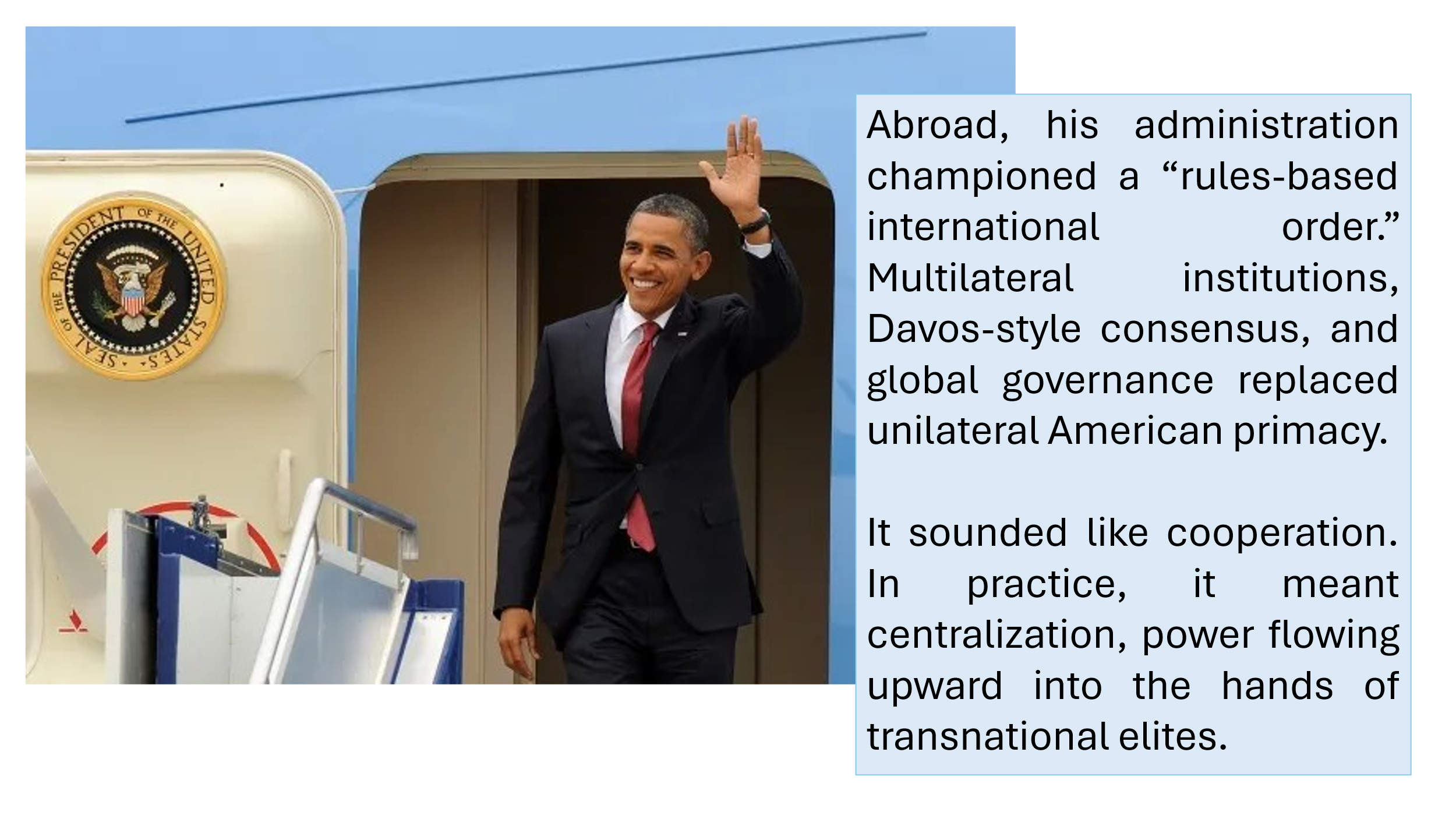
At home, the Dodd‑Frank Act was sold as a crackdown on Wall Street. In reality, it entrenched “too big to fail.” Banks were designated as systemically important, but none of the asset managers who quietly amassed trillions were touched. BlackRock, Vanguard, and State Street, the “Big Three”, rose unchecked. By 2024 they controlled more than a fifth of the S&P 500, wielding influence over corporate governance itself.
Meanwhile, regulators rewrote the fine print. Between 2010 and 2016, changes to the Uniform Commercial Code quietly subordinated depositors. Your bank account, your pension, your IRA, legally reclassified as “entitlement rights,” unsecured claims behind the creditors. No new law was debated. No headlines blared. It was done in committee rooms while the public looked elsewhere. No more bail outs from the government. Next time, it will be a bail in and you foot the bill.
The message was clear: the crisis was not a failure of elite control. It was a consolidation of it. The public was told “never again.” In reality, the system was rewired to make “next time” even more profitable for those at the top.
Satoshi’s Shadow — The Ghost in the Machine
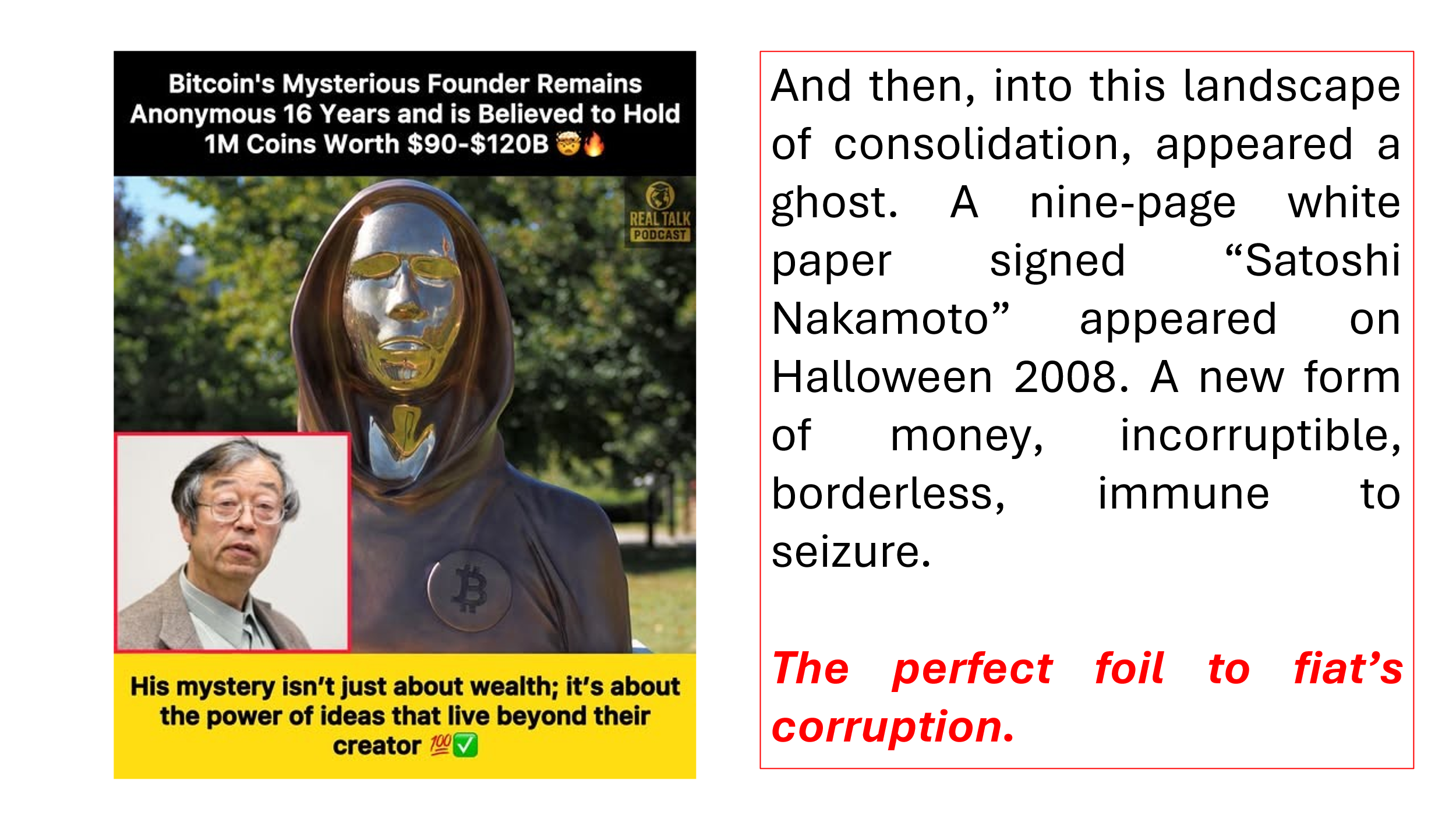
The first block was mined in January 2009 with the headline about bank bailouts embedded in the code, then vanished for good in the spring of 2011. Whoever they were, they left behind roughly a million bitcoins, more than a hundred billion dollars today, that have never been touched.
Some of the most convincing guesses point to cypherpunk pioneers like the late Len Sassaman, a privacy extremist who took his own life in 2011, or Adam Back, the British cryptographer whose 1997 “Hashcash” invention is directly cited in the white paper. An ephemeral spirit, a tragic genius, or a small team of libertarians who simply wanted sound money back, no one knows. The mystery itself became part of the legend.
Was this rebellion, or choreography? The most famous act of monetary protest in history was built on government cryptographic tools, released at the precise moment trust in banks collapsed, and then abandoned. The mystery itself became part of the legend.
For believers, Satoshi is a libertarian saint. For skeptics, the silence is louder than the code. A rebellion that never spends its fortune, never reveals its author, and never challenges the system directly begins to look less like resistance and more like controlled opposition.
CBDCs — The Pre‑Packaged Solution
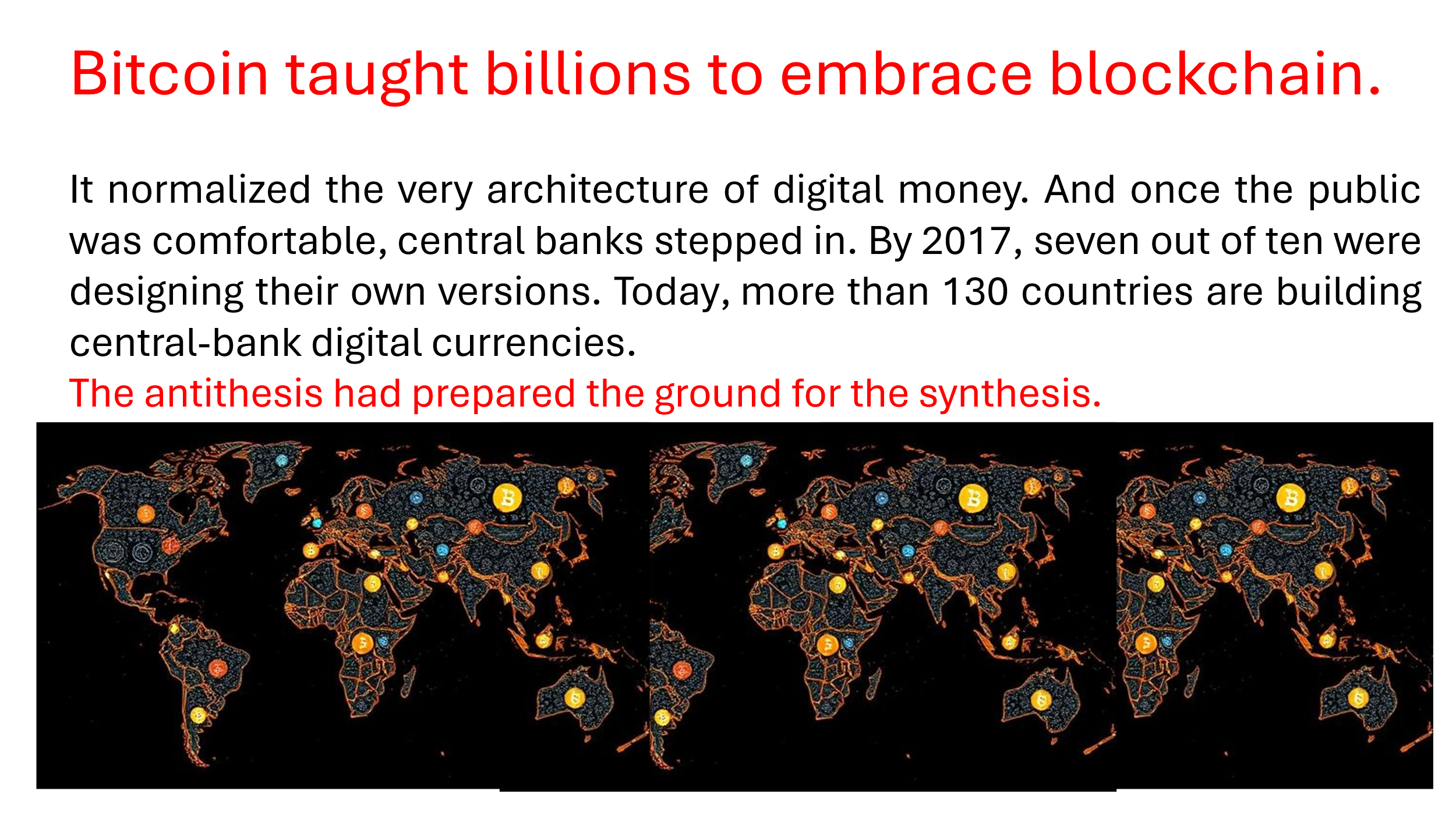
For six years after Bitcoin’s birth, central banks pretended it didn’t exist. Then, suddenly, they sprinted. By 2017, seven out of ten were designing their own digital currencies. Today, more than 130 nations are building central‑bank digital money.
The architecture is the same blockchain the public learned to love through Bitcoin, only now the master key belongs to the central bank.
And here’s the twist: the new system will not be sold as national control, but as international independence. The Bank for International Settlements, already running the mBridge project to connect cross‑border CBDCs, will present itself as the neutral referee. No more local manipulation, no more corrupt politicians, just a global clearinghouse “above politics.” What sounds like protection is in fact consolidation.
The pitch will be irresistible:
- Trust us, we’re independent. BIS is not a government, but a supranational body with diplomatic style immunity. That distance will be marketed as virtue.
- Trust us, it’s efficient. CBDCs promise instant settlement, no friction, no borders.
- Trust us, it’s fair. AI will be deployed to monitor flows, detect fraud, and “ensure equality.”
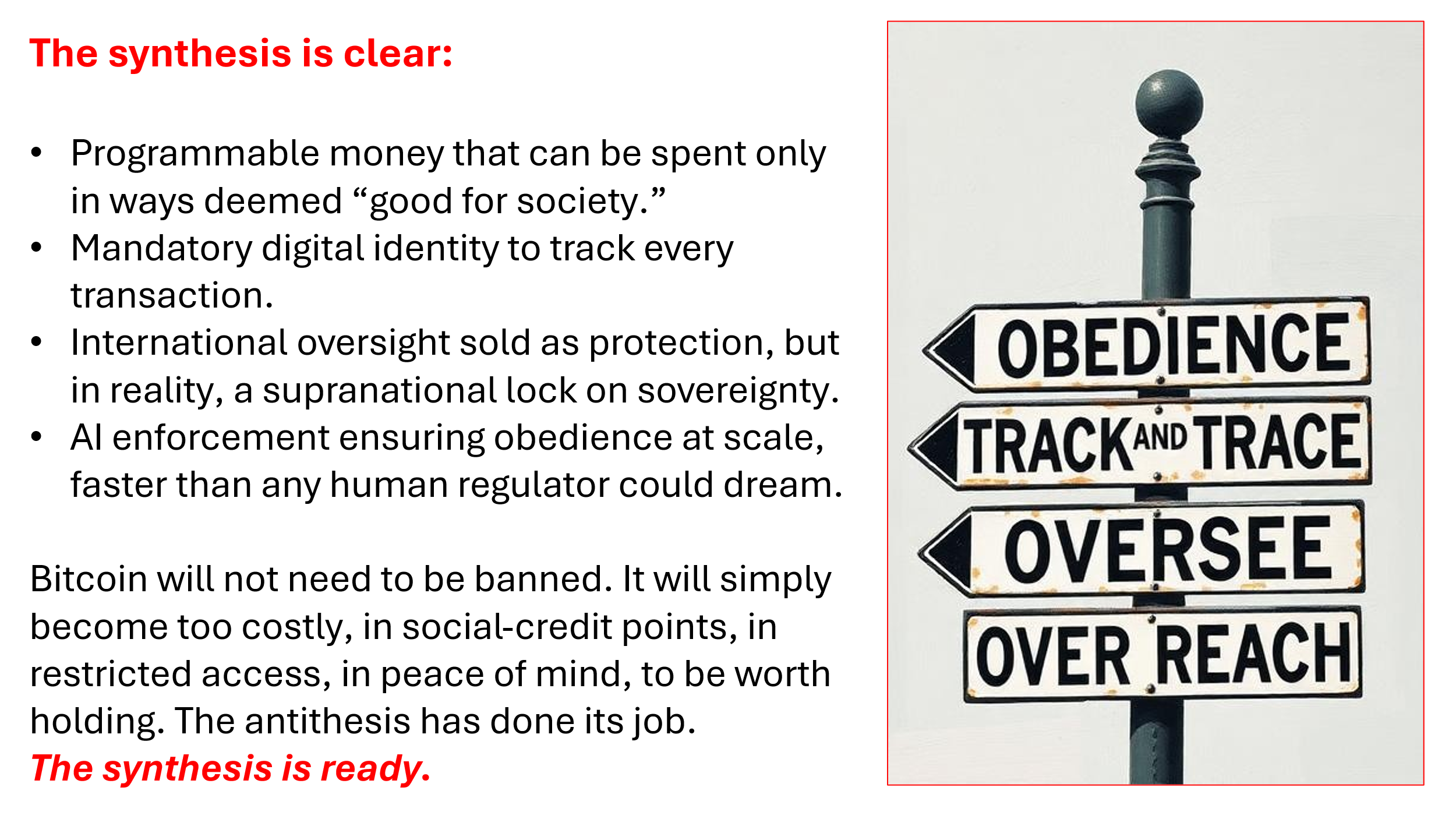
But tomorrow’s bogeyman is already visible. AI will not just sit beside the system; it will “run” it. Algorithms will decide which transactions are “suspicious,” which purchases are “responsible,” which citizens are “compliant.” Programmable money plus machine judgment equals a monetary prison with no visible guards.
Conclusion — Dominoes Falling
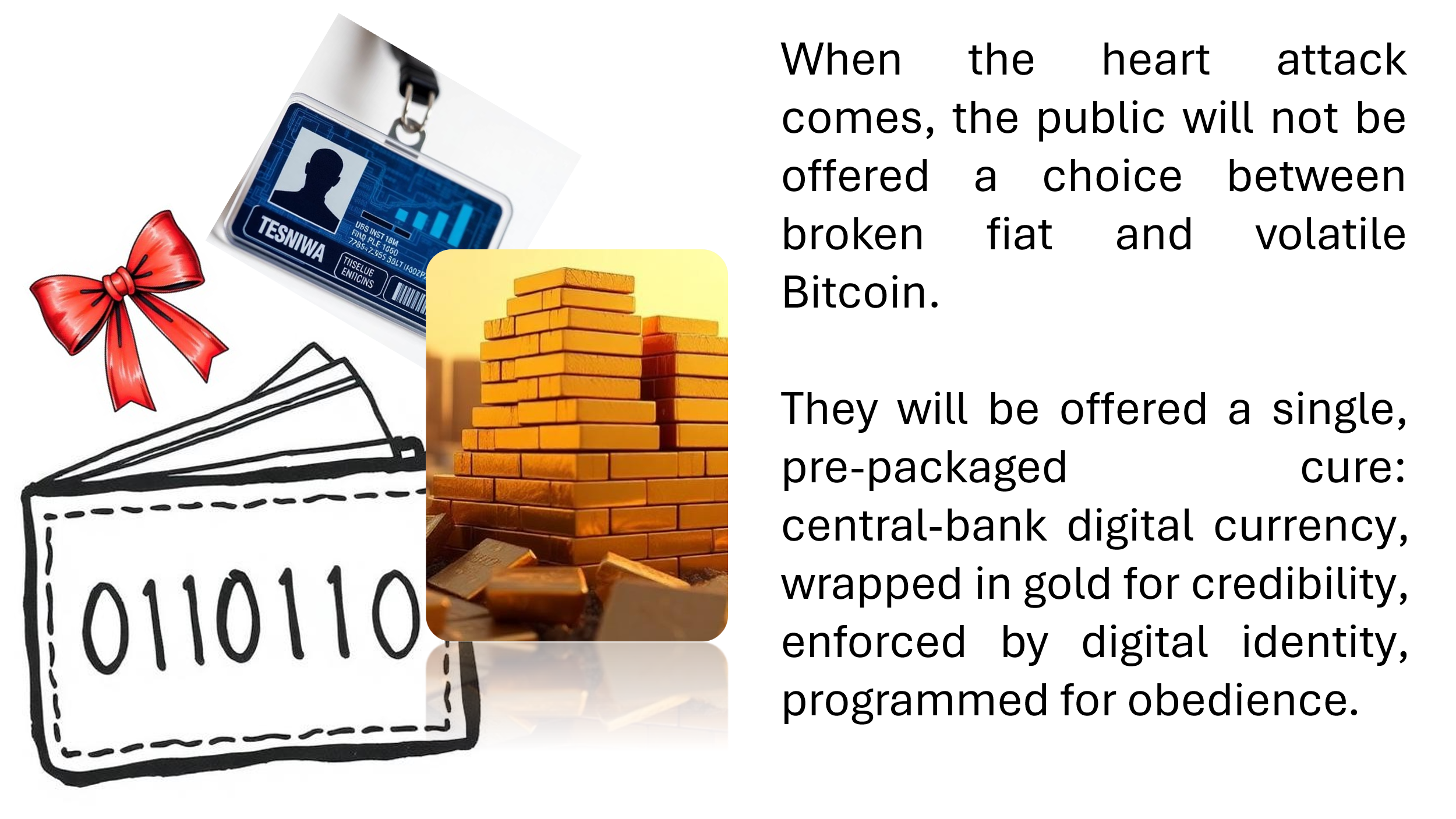
Bitcoin was sold as rebellion. Fiat was exposed as rot. But the real prize was neither. The real prize was teaching billions to embrace digital money, so that when the next crisis arrives, the solution is already waiting.
A crisis appears to be forthcoming. Possible catalysts include a failed Treasury auction, volatility in the Japanese bond market, or escalating tensions in Europe as NATO and Russia face increasing conflict; the factors contributing to such outcomes are already present.
Similar to the developments following World War II in 1944, there is potential for Globalists dressed as international policymakers and financial leaders to convene and establish another Bretton Woods-style agreement.
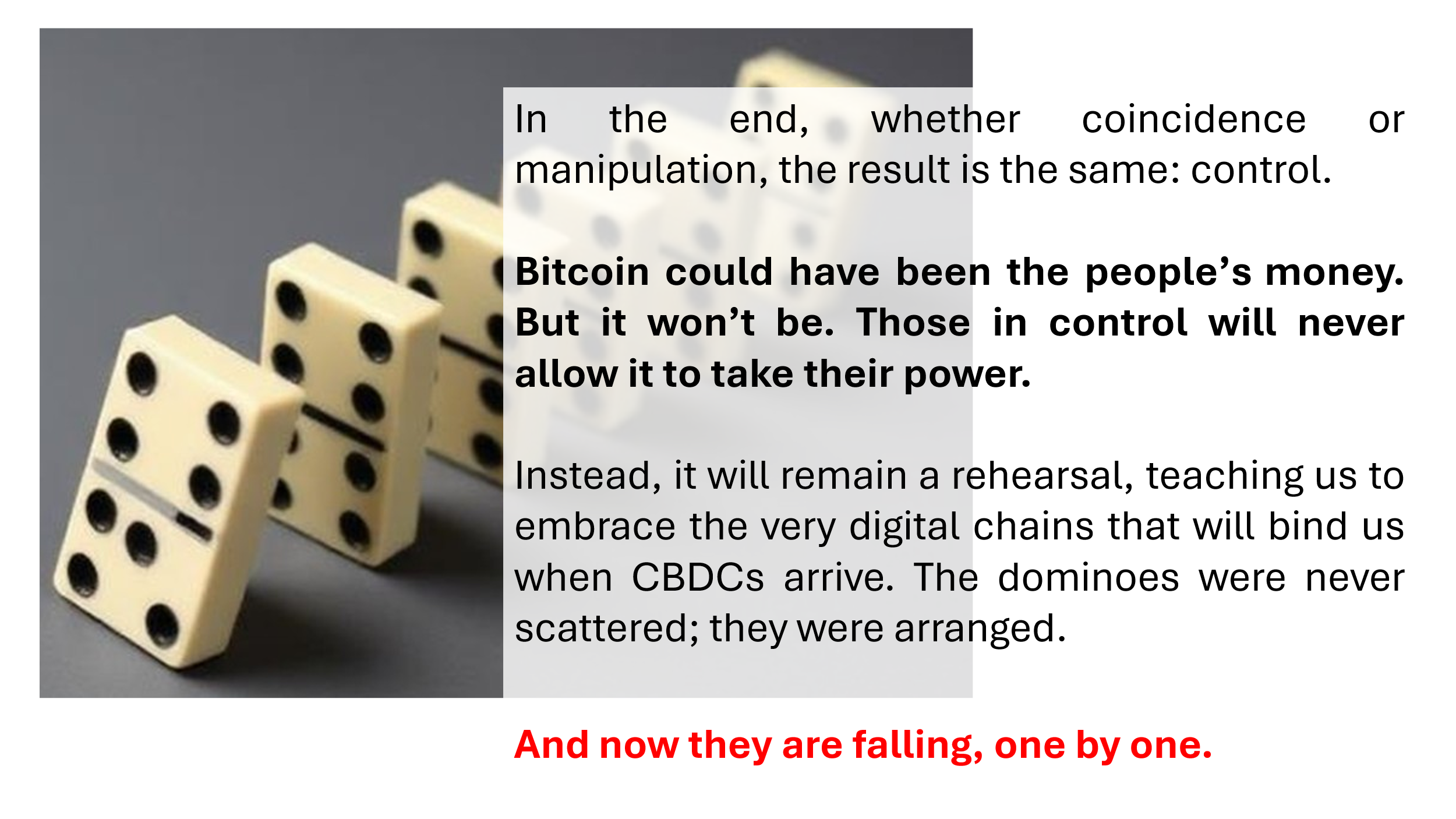
Maybe it’s coincidence. Maybe a lone genius timed the greatest monetary protest in history and then vanished. Or maybe the dominoes were arranged long ago, and we are simply close enough now to hear them start to fall.
 Executive Summary
The 2008 financial crisis shattered public trust in the global monetary system. Six weeks after Lehman Brothers collapsed, the Bitcoin white paper appeared, offering a form of money supposedly beyond state control. The timing seemed almost intentional: as confidence in fiat evaporated, a decentralized alternative emerged. Yet seventeen years later, global debt has surged, major banks are even larger, and Bitcoin’s price movements mirror the very financial system it was meant to oppose. This raises the question of whether Bitcoin was an escape—or a step toward a new, more controlled digital order.
Global government debt now exceeds $100 trillion, with Japan above 230% debt-to-GDP and the U.S. near 120%. This crisis stems from decades of technocratic mismanagement: wars financed by deficit spending, unreformed welfare systems, quantitative easing that inflated asset markets for elites, and pandemic spending that widened wealth inequality. The same experts who missed the 2008 warning signs continue to guide policy, often in synchronized ways that blur the line between coincidence and coordination. Public trust in fiat stewards is fading.
Bitcoin was expected to serve as a decentralized hedge, but its tight correlation with macroeconomic trends undermines its promise as a financial lifeboat. The 2008 crisis revealed deep flaws in fiat: reckless lending, derivative excess, and bailouts that protected banks while ordinary citizens bore the cost. Power consolidated as major institutions grew larger and accountability vanished. In this context, Bitcoin emerged as a counter-narrative, timed precisely when trust hit its lowest point.
Post-crisis reforms under the Obama administration further centralized power. Dodd-Frank entrenched “too big to fail,” asset managers like BlackRock and Vanguard expanded unchecked, and quiet regulatory changes paved the way for future bail-ins. Internationally, authority shifted toward supranational bodies.
Bitcoin’s mysterious origins—from NSA-linked cryptography to Satoshi’s disappearance—add to its ambiguity. Regardless, Bitcoin normalized blockchain, enabling the rise of central-bank digital currencies now being developed in over 130 countries. CBDCs, combined with programmable features and AI surveillance, could enforce behavior automatically, making alternatives like Bitcoin impractical.
Whether intentional or accidental, Bitcoin prepared society for a centralized digital monetary regime—one likely waiting for the next crisis to be unveiled.
Sources:
https://www.imf.org/en/blogs/articles/2024/10/15/global-public-debt-is-probably-worse-than-it-looks
https://www.coinlore.com/coin/bitcoin/historical-data
https://www.in2013dollars.com/bitcoin-price
https://en.wikipedia.org/wiki/Emergency_Economic_Stabilization_Act_of_2008
https://www.investopedia.com/articles/economics/09/american-investment-group-aig-bailout.asp
https://www.investopedia.com/terms/d/dodd-frank-financial-regulatory-reform-bill.asp
https://www.congress.gov/crs-product/R41350
https://supra.com/academy/the-nsa-and-bitcoin-origins-of-the-sha-256-hashing-algorithm/
https://www.bis.org/about/bisih/topics/cbdc/mcbdc_bridge.htm
https://www.cryptopolitan.com/uae-central-bank-mbridge-cbdc-china/