
COVID did more than disrupt economies and public health systems; it exposed something deeper about how modern governance works. People watched, stunned, as governments from all over the world adopted the same policies in the same sequence, often with the same blind spots and the same constitutional overreach.¹
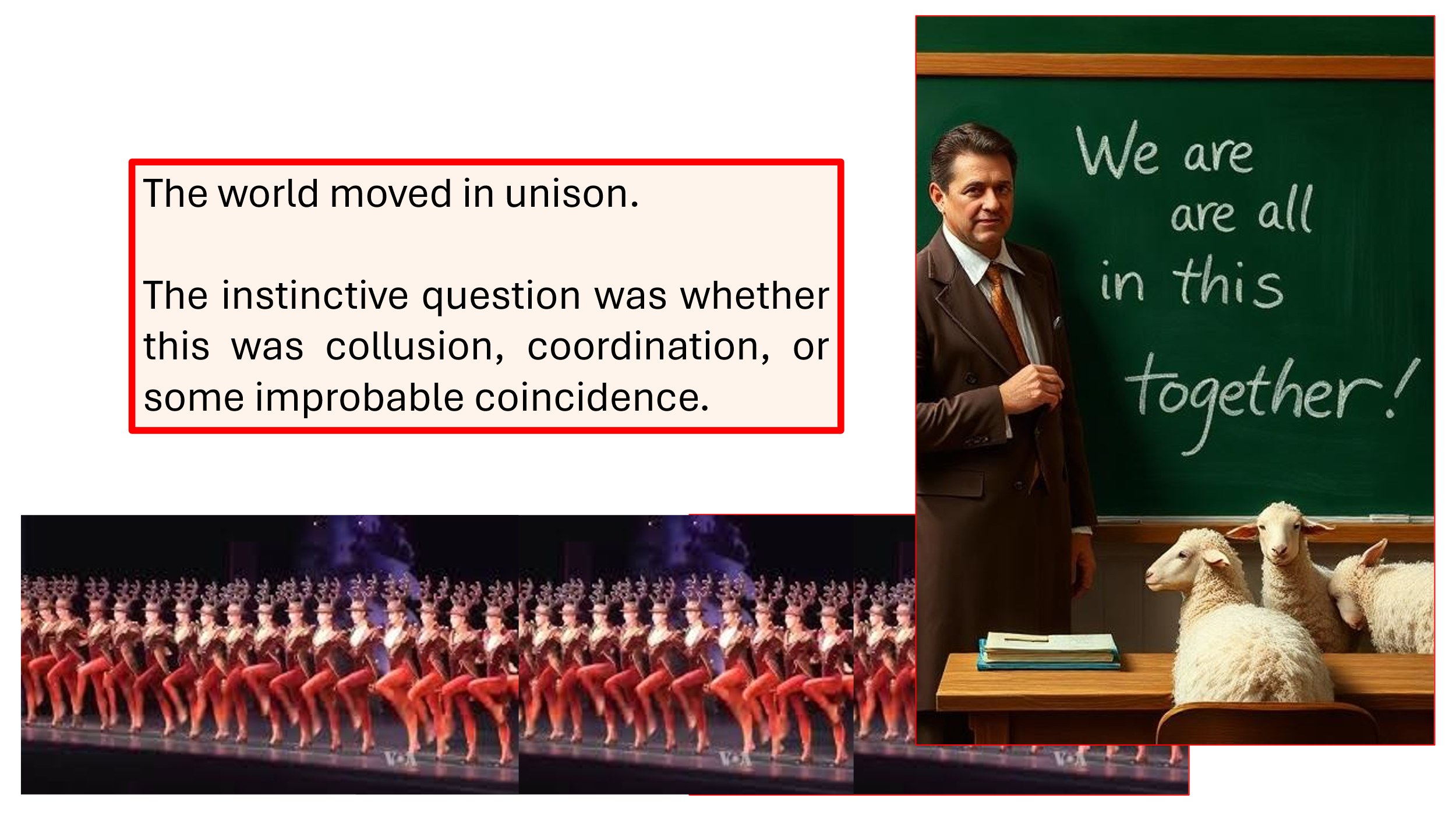
The real answer is simpler and far more unsettling. Even though the Globalists have indeed developed vast amounts of agendas, strategic policies, plans, and guiding principles, as well as the resources, structures and mechanisms needed for their New World Order, there is something far deeper one need examine. Just what is it that ultimately fosters this unison, this lockstep of efforts. This is their underbelly, unseen, but foundational and consistent.
It is a lockstep of the mind, the “Us and Them” paradigm, which acts as the Oz behind the emerald curtain of Globalist action worldwide.
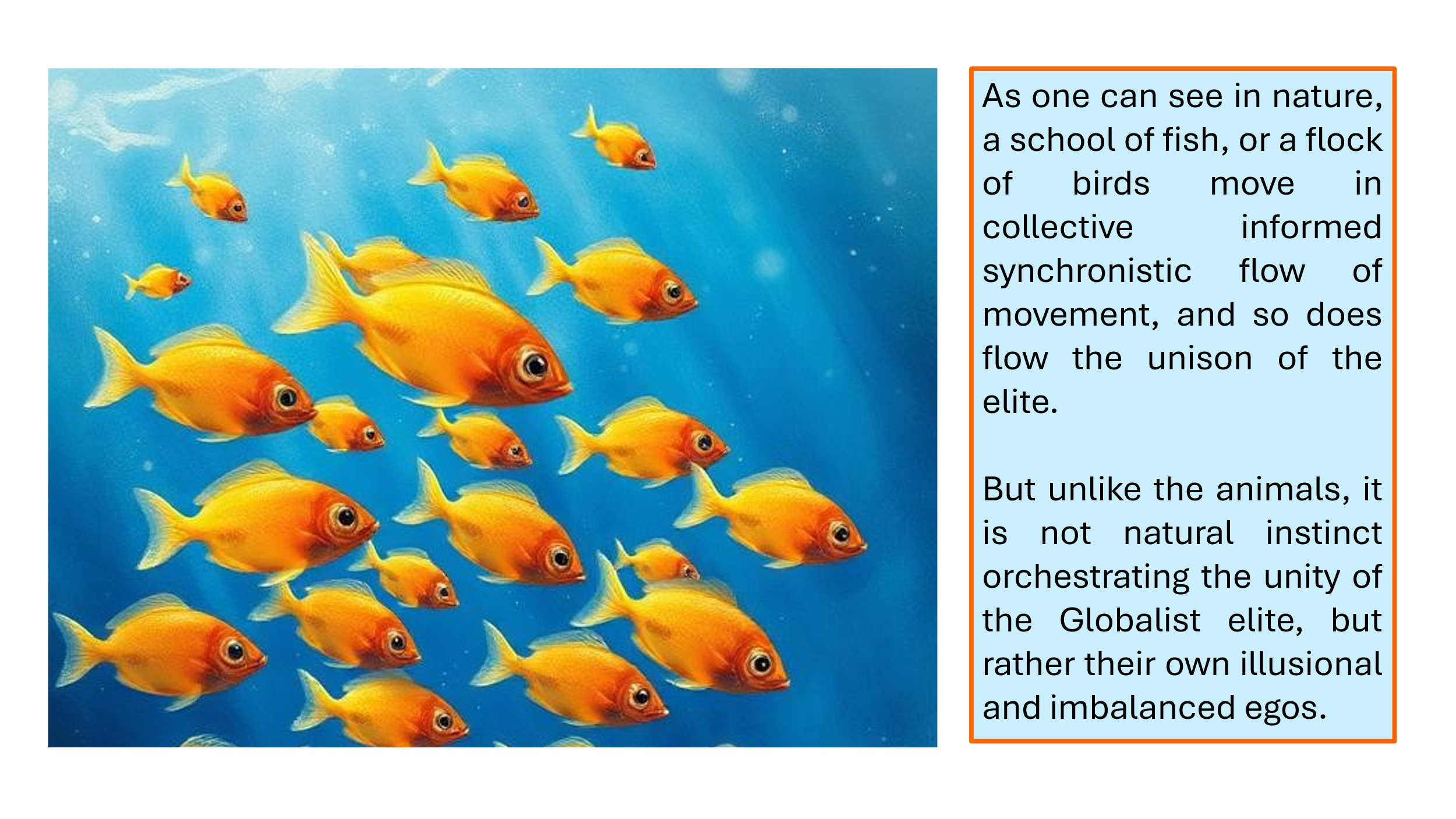
Their visions for Humanity lie within their own unshakable ego minds, who tell them it is their destiny, because they are so privileged, to save the myopic and simple little people from themselves. Preventing the masses from wasting all the resources and dirtying up the planet even more, is an auxiliary goal.
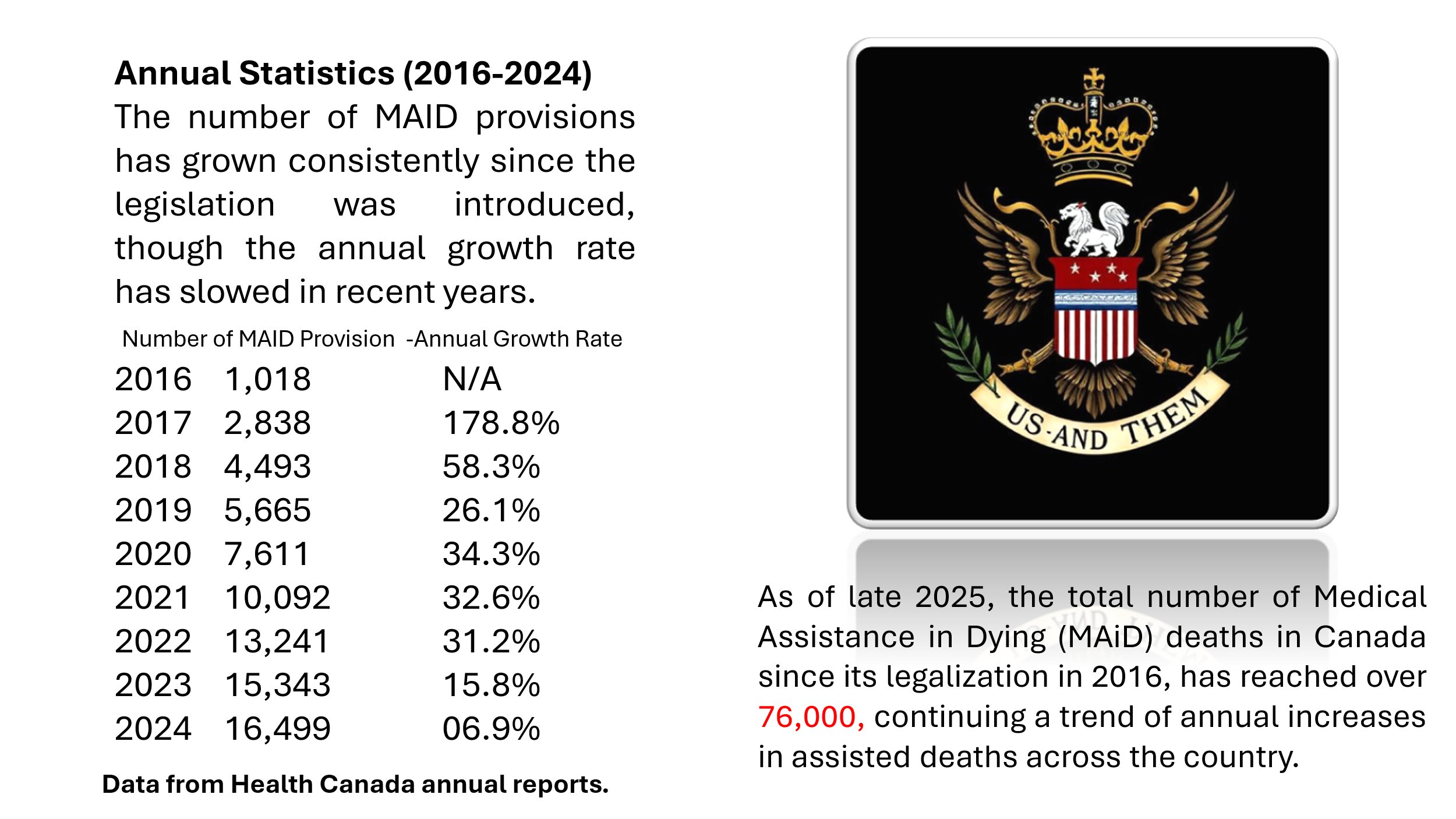
Think about it, one of the Globalist key “advisors”, is the fine boned slip of a man, Yuval Noah Harari, whose pet name for the masses is “useless eaters”. Another example is the petit Mark Carney, Prime Minister of Canada, who appears proud of the fact that the fifth cause of death in his country, is the Government run, free of charge, MAiD program. MAiD stands for – Medical Assistance in Dying, where citizens – poor and paralyzed, mature minors and mentally ill, (coming in 2027) or healthy but depressed, for example, can apply for MAiD, to then be given their “offing” by the hand of the Crown.
No need for more examples. I think it is clear the Globalist elite think we are not like them. So that is the inner realm of the psychology that can allow one human being to attempt capture of another’s sovereignty. No sovereignty, no freedom, no quest for innovation.

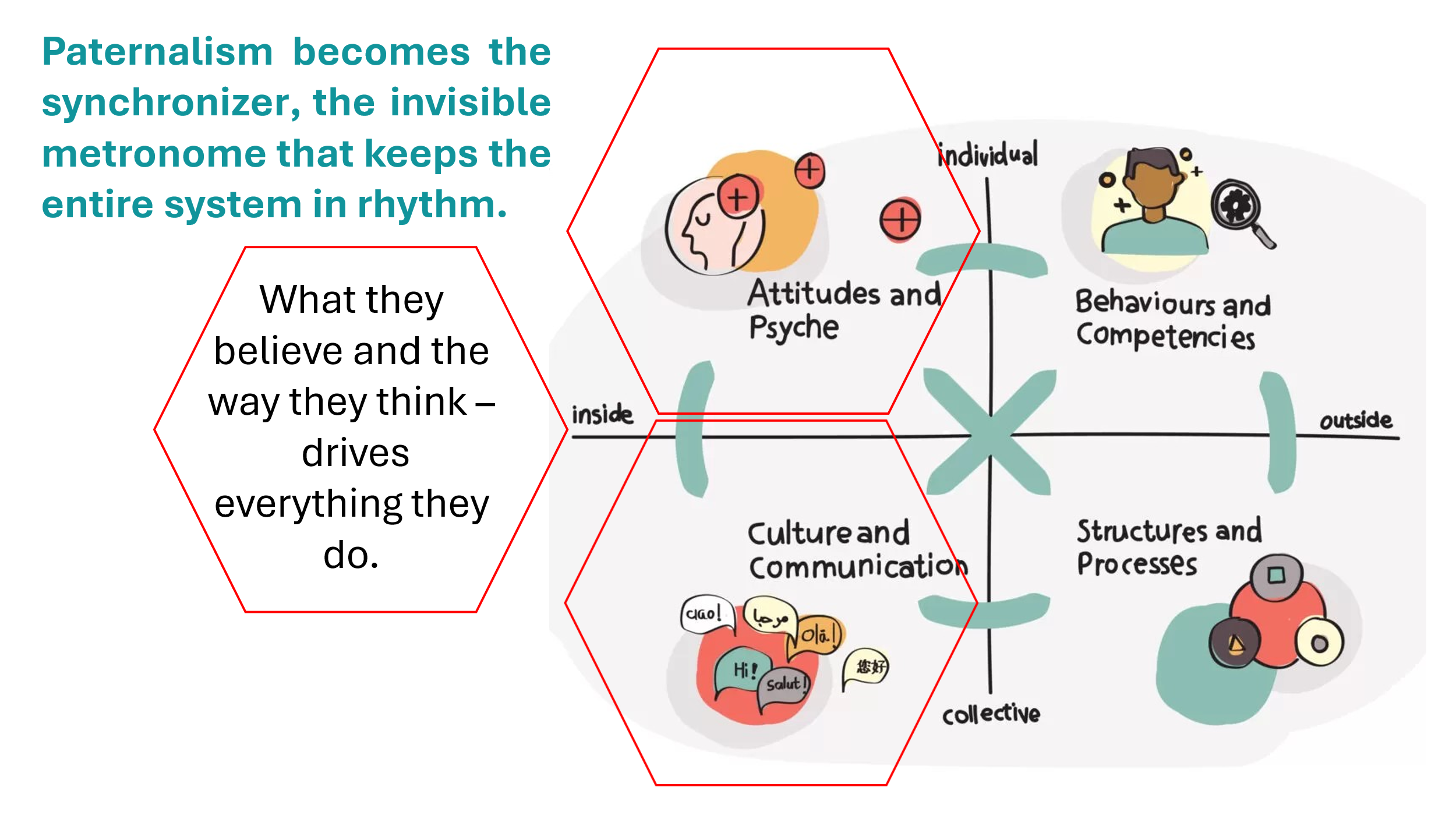
Implementing Globalist Agendas such as Agenda 2030/Sustainable Development Goals, or the Climate Change Frameworks requires much coordination, and structures and mechanism are established to do this. At the same time, implementing runs smoothly, with few snags or questions, when paternalism is the dominant psychology. When every major institution trains its directors to see themselves as guardians, rather than representatives, they will pretty much make the same, or similar decisions, at the same time.
This is not because they consciously conspire at their levels, mostly not, although “planning” indeed is done at the highest Globalist levels, but because they share the same mental model of what “responsible governance” requires. At the same time, bigger picture macro visioning is rolled out at the various annual Globalist gatherings and support for all aspects of implementing this vision is generous, allowing the visions to then trickle down into society.
The New Paternalism
Over the past decade, this collective paternalism has shaped policy in many countries, many of them “first world”. Governments have embraced sweeping agendas said to be meant to save the planet, correct social imbalances, and manage long-term risks.
Yet the results have been rising costs, shrinking opportunity, and a quiet erosion of democratic agency. Nowhere is this more visible than in Europe, where a self-reinforcing doom loop has taken hold: carbon clean Net Zero targets designed without technological pathways, regulatory layers that smother experimentation, stagnant growth, and declining competitiveness.²
At some point it becomes clear this is not mere incompetence. It is the predictable outcome of a system that treats innovation as a threat rather than an asset. Europe has not produced a game-changing technology in decades, and that absence is not accidental.³ It is the logical expression of a worldview that prioritizes stability over dynamism, predictability over disruption, and managerial control over creative risk. Docile, malleable and government dependent, does not a creative innovator usually become.
The Rules-Based Order
To understand why these patterns appear simultaneously across nations, you have to understand the ecosystem that produces them, the so-called rules-based order.
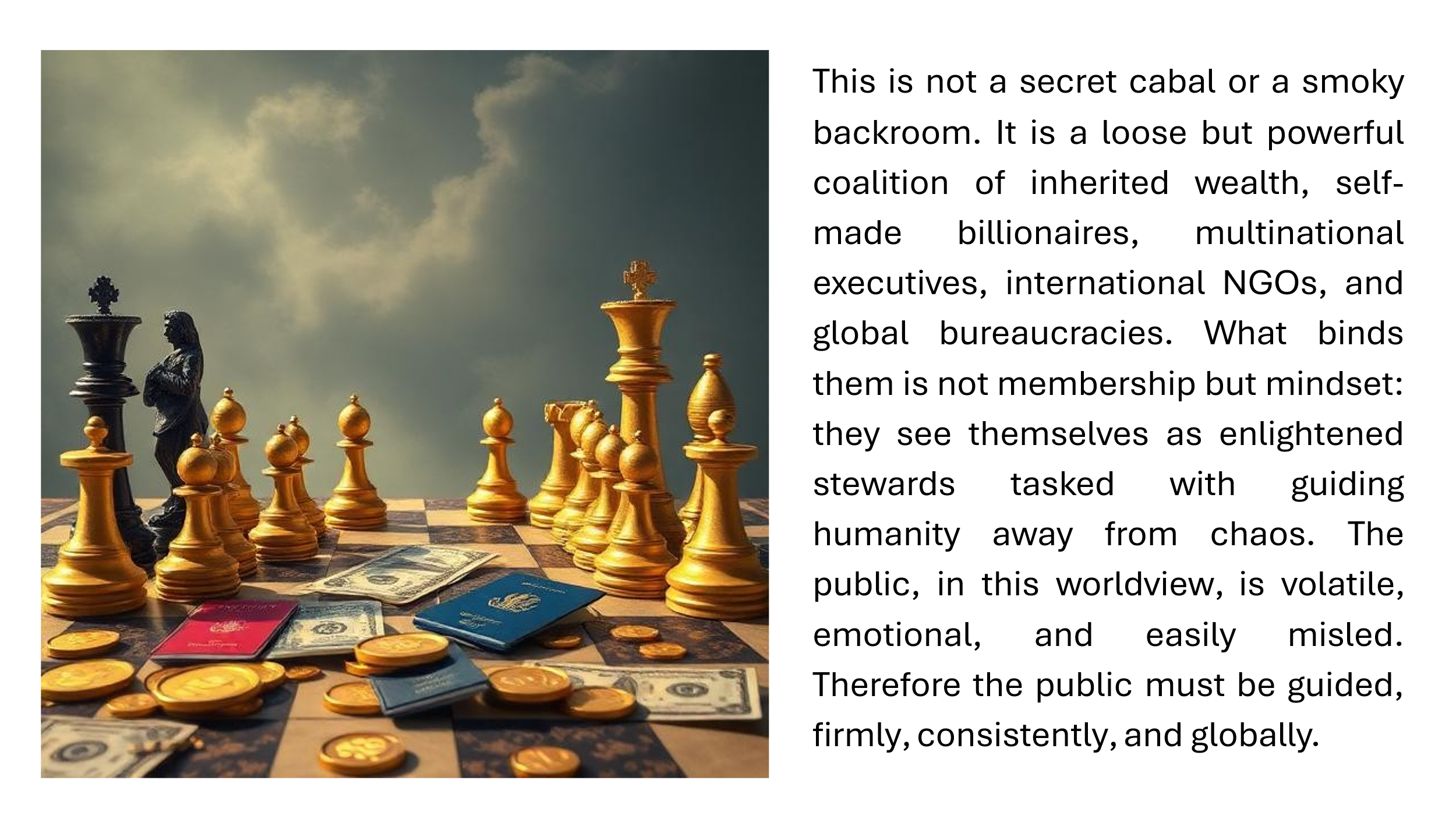
You don’t have to believe in a hidden club to see the pattern. When the same complex policies appear simultaneously across dozens of countries, often overriding clear national economic interests, something is synchronizing them. Call it convergence, call it elite consensus, call it a rules-based order. The label matters less than the outcome: a shared playbook that prioritizes global standardization over national dynamism.

Leaders who resist find capital more expensive, allies scarcer, and media coverage hostile. The system doesn’t need explicit orders, it only needs rewards for compliance and punishments for deviation.
Within this framework, government is not “ours” in any meaningful sense. We vote for the faces, but the machinery, the donor networks, the international commitments, the regulatory class, is heavily influenced by the coalition. Leaders who deviate from the consensus are swiftly marginalized. Liz Truss, former UK Prime Minister, lasted just forty-five days when she challenged the orthodoxy.⁴ The system does not need to remove every dissenter; it only needs to make an example of one, every now and then. Policy tends to stay within approved parameters no matter who wins the election.
Standardization as Control
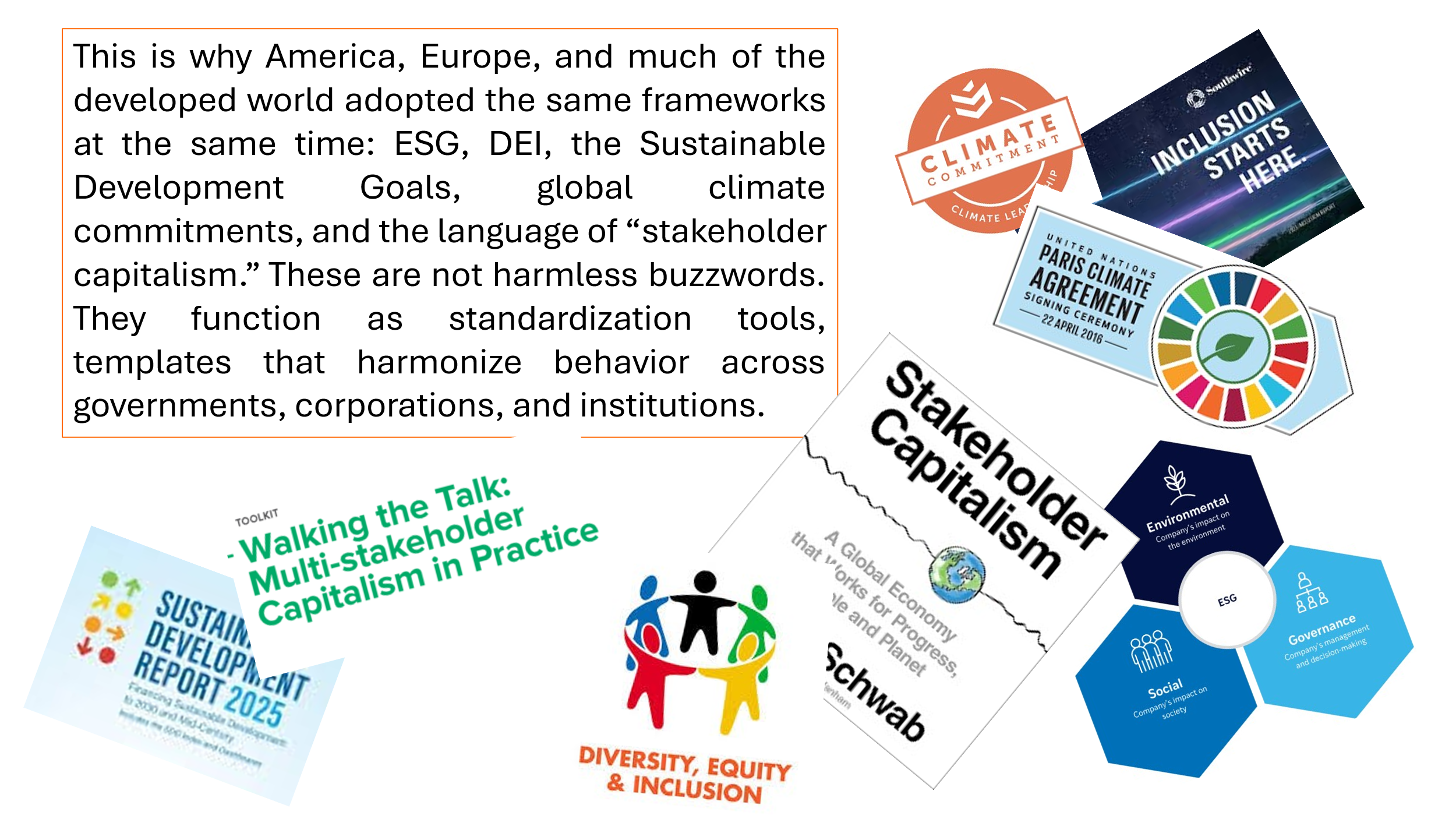
They steer capital, define acceptable risk, shape regulation, and reward compliance. They create predictable global baselines. And they suppress the volatility that genuine innovation requires. Breakthroughs that could disrupt dependencies or destabilize the global order are treated as dangerous. Better to throttle them.
This is a root cause of the affordability crisis. Costs rise and growth dwindles.
The Limits to Growth Mindset
Many assume these frameworks were born in Davos or at elite policy summits. But their intellectual roots run deeper, back to the Club of Rome, founded in 1968 to study what it called the “world problematique.”⁵
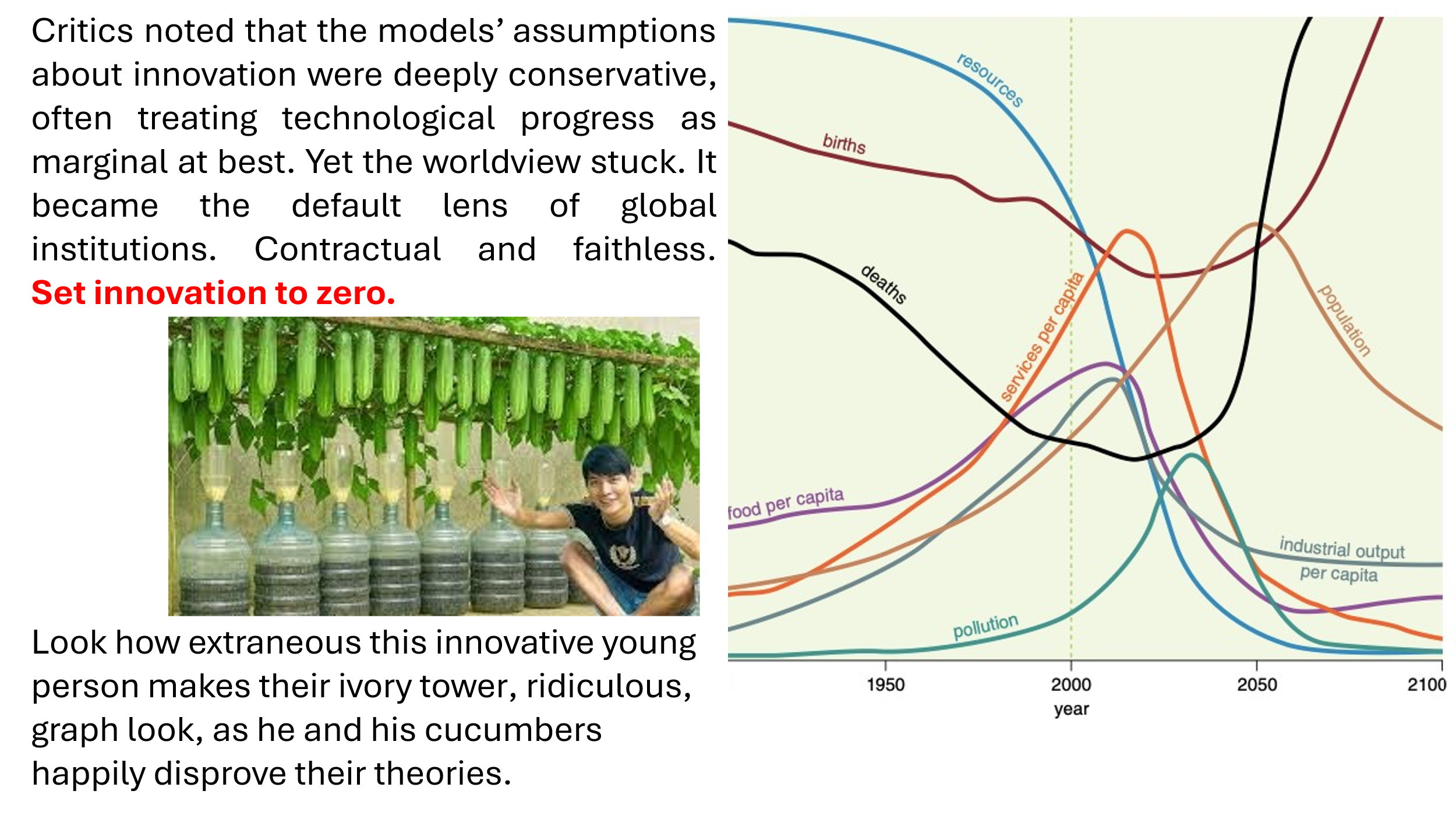
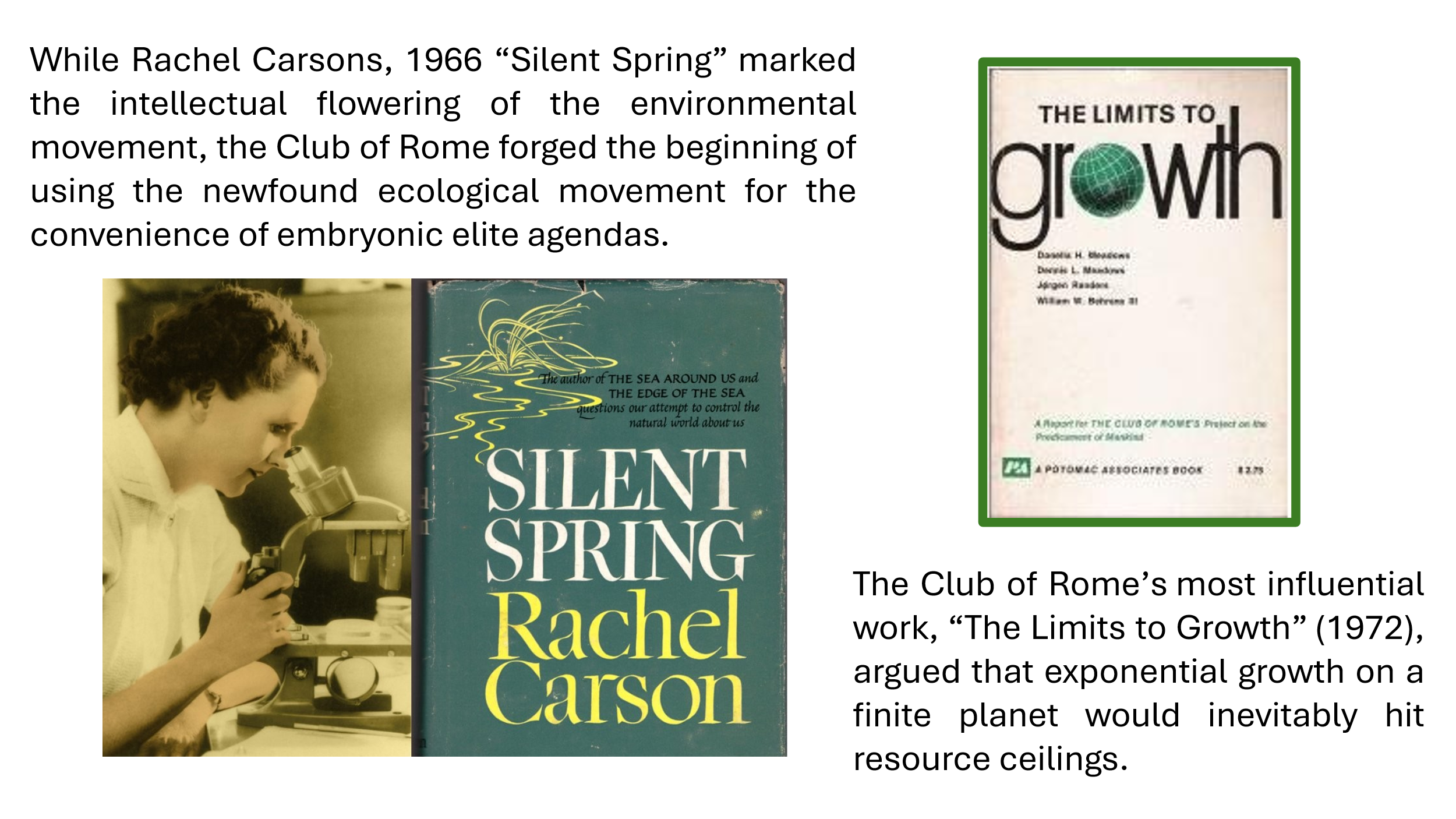 Limits to Growth modeled population, industrial output, food, resources, and pollution, and concluded that without deliberate stabilization, collapse was likely.⁶ The worldview embedded in the report, fixed limits, fragile systems, the need for managed decline, seeped into environmental ministries, international development agencies, global governance bodies, academic economics, and was a key foundational source for conceptual sustainability frameworks.
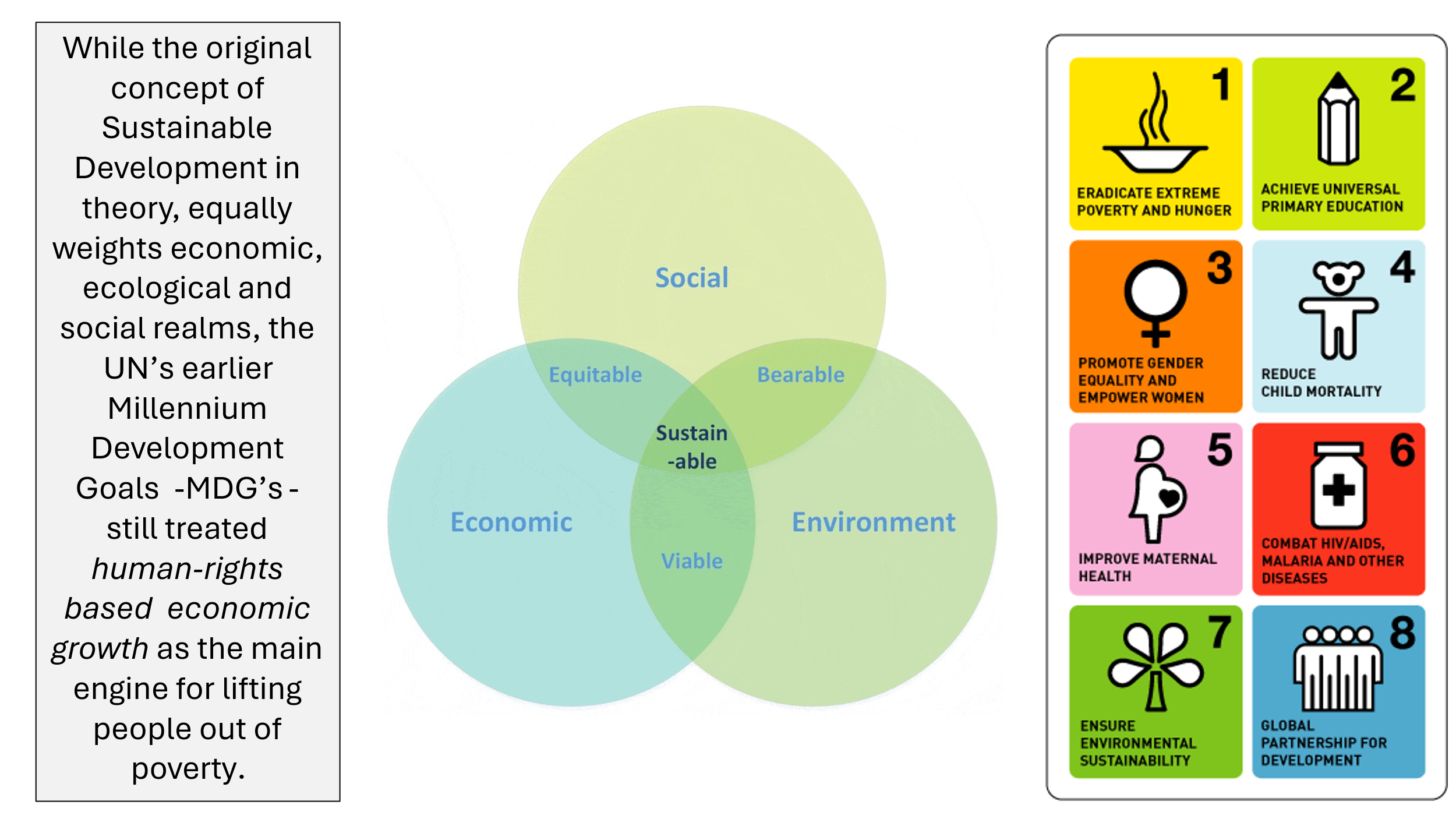
Their successors, the Sustainable Development Goals, more fully embrace the Club of Rome’s logic: exponential growth must be bounded, resources carefully managed, and global systems deliberately stabilized, even if that requires accepting lower material throughput in the developed world.⁷
The Schism Ahead
This brings us to the present moment. For decades, the rules-based order operated on a single assumption: innovation cannot outpace resource constraints, and therefore growth must be managed downward.
But a breakaway faction, especially in the technology world, rejects that premise entirely. They believe innovation is not a variable to suppress but the force that can rewrite the constraints themselves. Donald Trump, championing deregulated AI, abundant domestic energy, and “drill, baby, drill”, has become the political face of this new faction.⁸
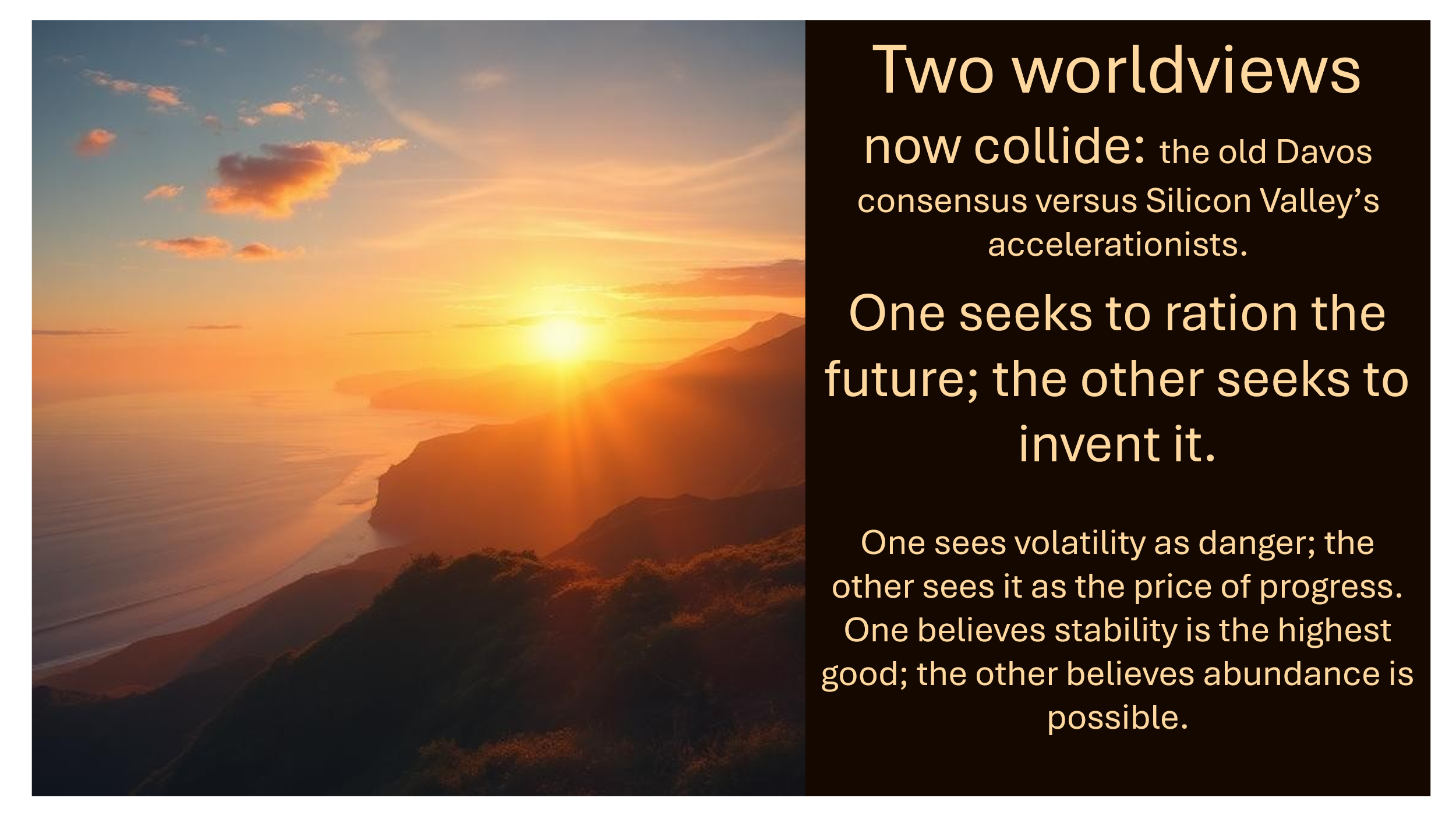
This is the real conflict of our time. Not left versus right. Not nation versus nation. But paternalism versus dynamism. A system built on stability is meeting a faction built on acceleration. Conflicting realms is not a possibility. It is a mathematical certainty.
We see it already in disputes over AI governance, energy abundance versus Net Zero rationing, and the future of free expression online, flashpoints where acceleration meets resistance.⁹
While each step towards stopping Globalist rule is a golden brick in our noble and collective restoration, and while real efforts have worked towards stunting globalist ambition from Davos, and the UN set alike, we must understand with a one clarity of vision, that power has shifted. The reality is that we have in some ways and in part exchanged Rules Based Davos for Silicon Valley. That in no ways means that one is the same or “just as bad” as the other, and recall the variance within the elite. The Rules Based Order have their clear and ready Transhumanist Plans. They are public.
We stand at a crossroads, and ridding the world of the risk of the Davos Set is a gain at any rate, but we still do not know what the alternative power dynamics mean or how they will play out. The future interactions of all global power players is an absolute unknown too. What we do know is, that today We the People certainly still, in no way, chart our own course.
One other certainty is that however much we think government is based upon “We the People,” there will always be an unelected minority that will attempt to shape the direction, one way or another. Our collective goal is to checkmate that as much as possible, at the outset, and ensure oversight and accountability at all times for all levels.
With enough creativity and innovation, Humanity can operate under a democratic framework.
Let us continue to climb to that summit.
JOIN US.
republic.us
USACitadel, a private, invitation-only platform created by Our Country Our Choice. It took time because we are fueled only by our members, not big donors or special interests. This platform is free and built to serve Americans, not the globalists.
Here, you’ll be able to connect in forums, organize with like-minded patriots, and help build a stronger America—county by county, state by state. Together, we will form a safety network, protect each other, and grow into a force of tens of millions strong.
You will likely have received your complementary invitation. Once inside, you can invite more like-minded patriots to join us. This is how we grow. This is how we unite. This is how we communicate and protect one another. Together, we will build a safety network in every county across America.
We need your participation and your help to grow our membership into the tens of millions. Only then will we have a true force for the Americans First movement.
Endnotes
- Studies have documented the rapid synchronization of COVID-19 policies (e.g., lockdowns, testing, and restrictions) across countries. See, e.g., Nature (2023) on policy effectiveness in 37 countries: https://www.nature.com/articles/s41598-023-31709-2
- Mario Draghi’s 2024 report on European competitiveness highlights regulatory burdens, Net Zero implementation challenges, and stagnant growth as key factors in declining competitiveness: https://commission.europa.eu/topics/competitiveness/draghi-report_en
- While Europe has produced notable innovations (e.g., ASML’s EUV lithography machines critical to global semiconductors), broad assessments note a relative lag in producing platform-level or consumer-facing “game-changing” technologies compared to the US or Asia in recent decades.
- Liz Truss served as UK Prime Minister from September 6, 2022, resigning on October 20, 2022 (45–49 days depending on counting method): https://www.bbc.com/news/uk-politics-63332037
- The Club of Rome was founded in 1968: https://www.clubofrome.org/
- The Limits to Growth* (1972) summary and original context: https://www.clubofrome.org/publication/the-limits-to-growth/
- The Millennium Development Goals (2000–2015) emphasized economic growth for poverty reduction, while the Sustainable Development Goals (2015–2030) are universal, incorporate environmental limits, and prioritize sustainability over unbounded growth: https://www.un.org/sustainabledevelopment/development-goals/ and comparative analyses, e.g., https://populationeducation.org/sustainable-development-goals-vs-millennium-development-goals-what-you-need-know/
- In 2025, the Trump administration issued executive orders removing barriers to AI leadership (e.g., preempting state regulations) and promoting energy abundance: https://www.whitehouse.gov/presidential-actions/2025/12/eliminating-state-law-obstruction-of-national-artificial-intelligence-policy/
- Recent shifts include BlackRock’s retreat from explicit ESG emphasis in Larry Fink’s 2025 letter, focusing instead on energy production: https://www.blackrock.com/corporate/investor-relations/larry-fink-annual-chairmans-letter and reports of broader corporate pullback.