
In this first of a two-part series, we examine the world we now inhabit, a world where contradictions multiply, certainties dissolve, and the very idea of reality feels negotiable. These distortions are not random. They are the visible seams of a system that political thinkers have mapped for more than a century – how an elite class hand down political formulas to society through a managerial class enforced even when they seem a strain on reality.
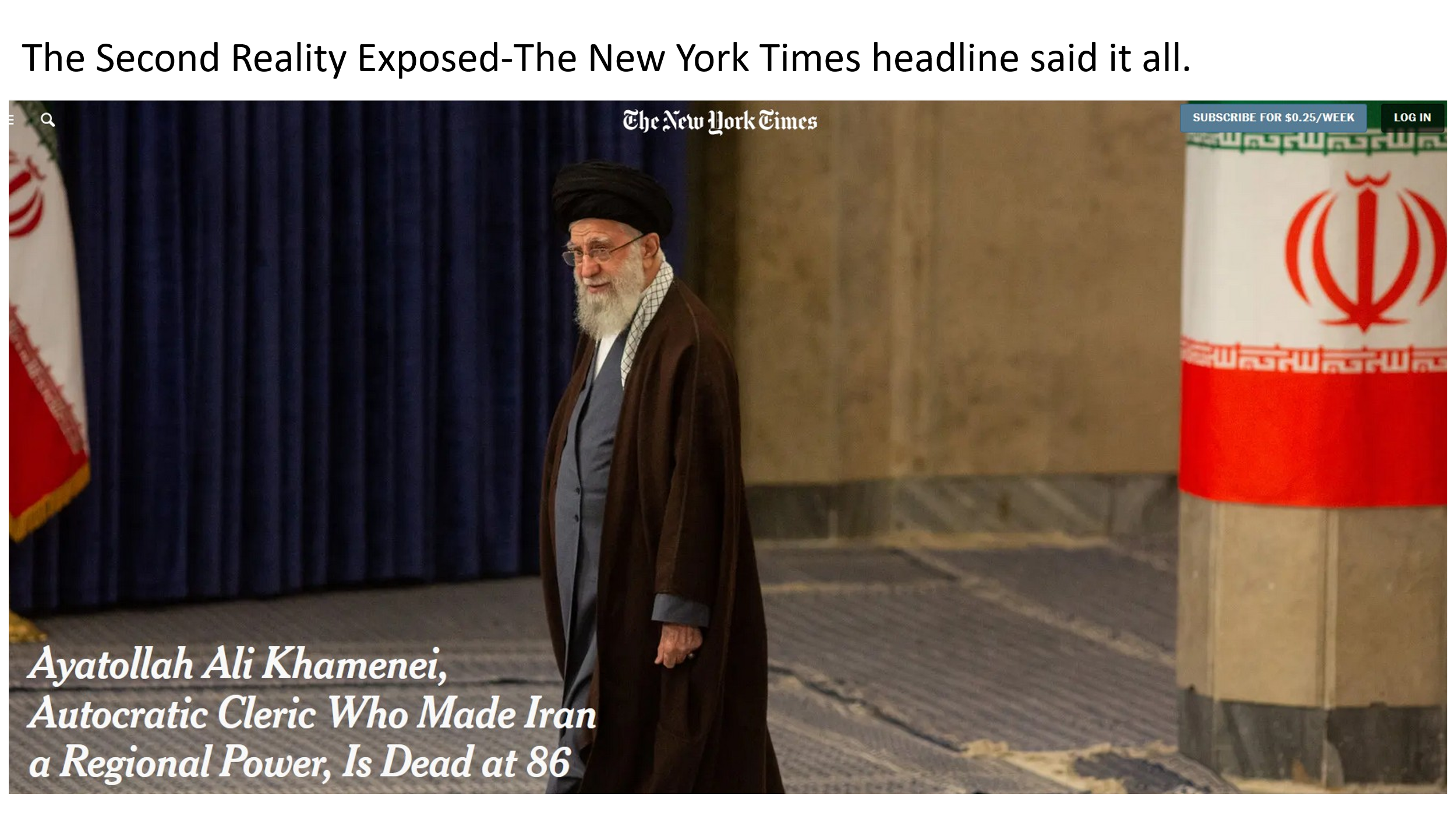
No mention of terrorism. No mention of the rivers of blood, the torture chambers, the crushed protests, the women beaten for showing hair, or the missiles aimed at his neighbors. Just another “regional power” success story[1].
This is not a glitch. It is the feature.
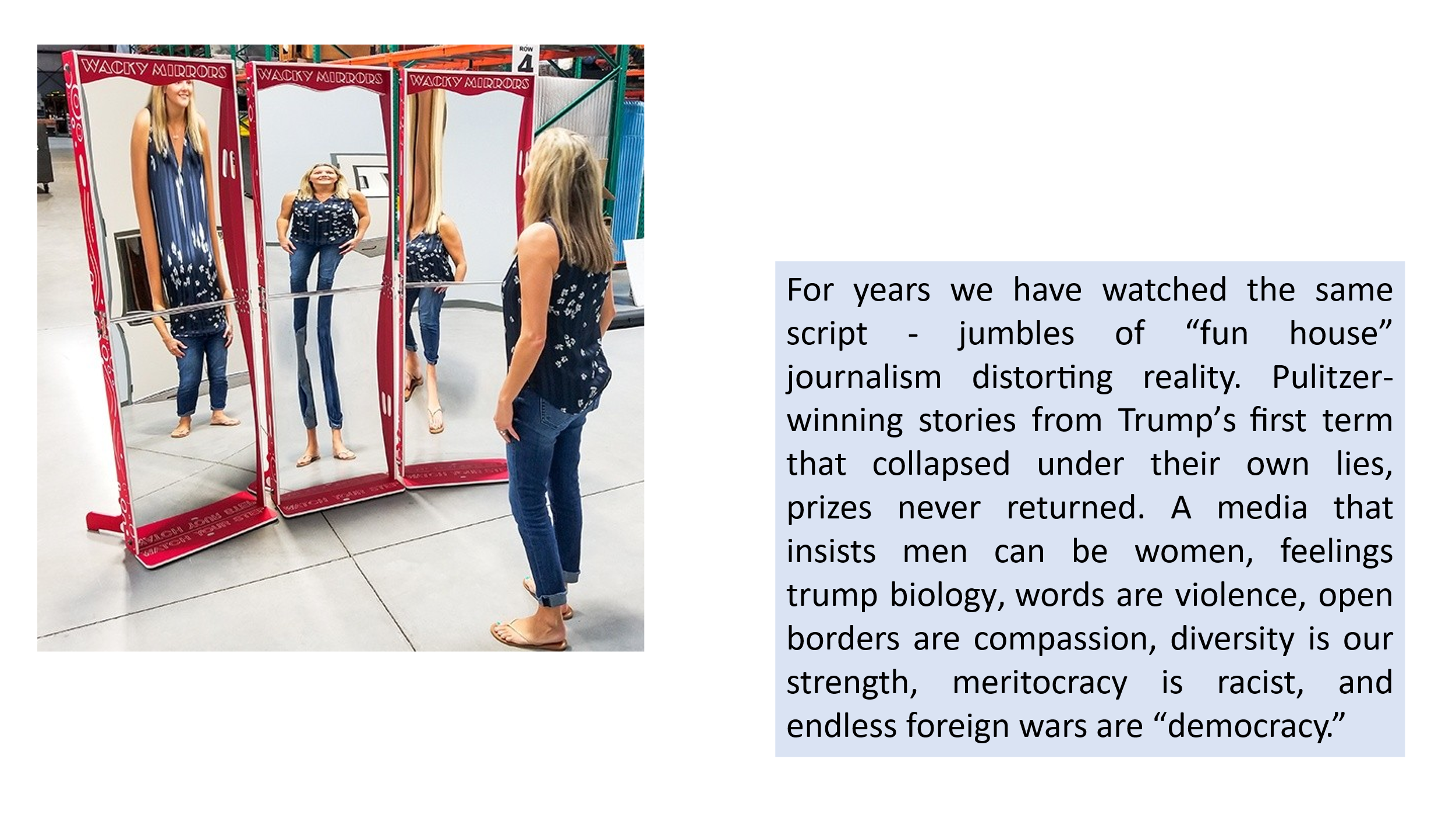
Refuse the script and the picture snaps into focus: the media does not report reality. It manufactures the reality it needs you to inhabit. Truth is optional; narrative is mandatory.
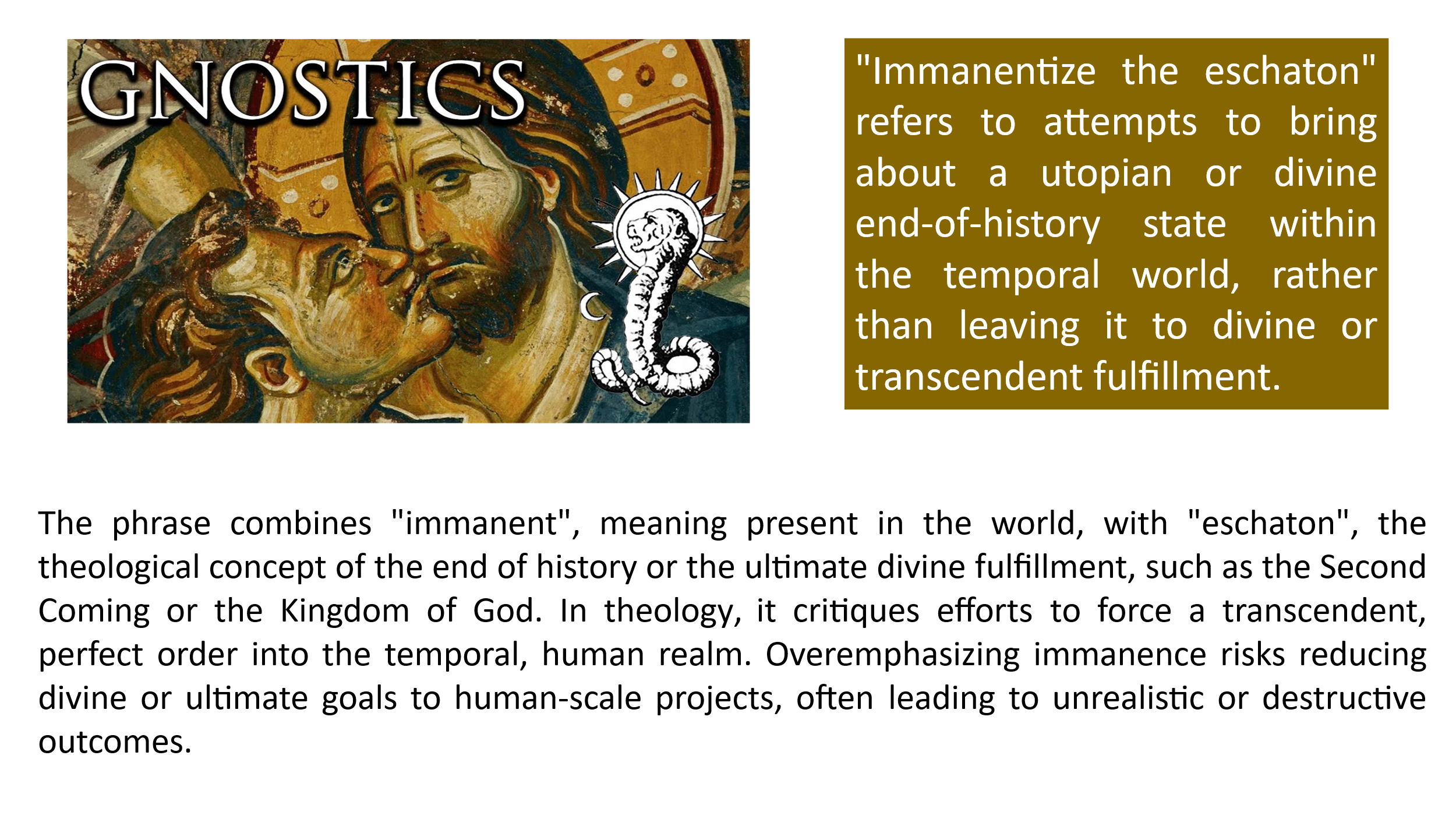
How can so many smart, credentialed journalists be this detached from reality? They aren’t. They are perfectly aligned with the reality they actually live inside, the “second reality” Eric Voegelin diagnosed decades ago. A Gnostic simulation built by elites who believe they can “immanentize the eschaton”[2]: drag heaven down to earth through technocratic management and replace God with their own administered order.
Younger generations never knew anything else. They were raised inside the second reality, so they cannot see it as constructed. They grew up without an anchor to the old America. It wasn’t just media; it was education and beyond. That is why so many now cheer for communism, tear down statues, chant “from the river to the sea,” and treat disagreement as violence. They are not rebelling against the system; they are performing it.
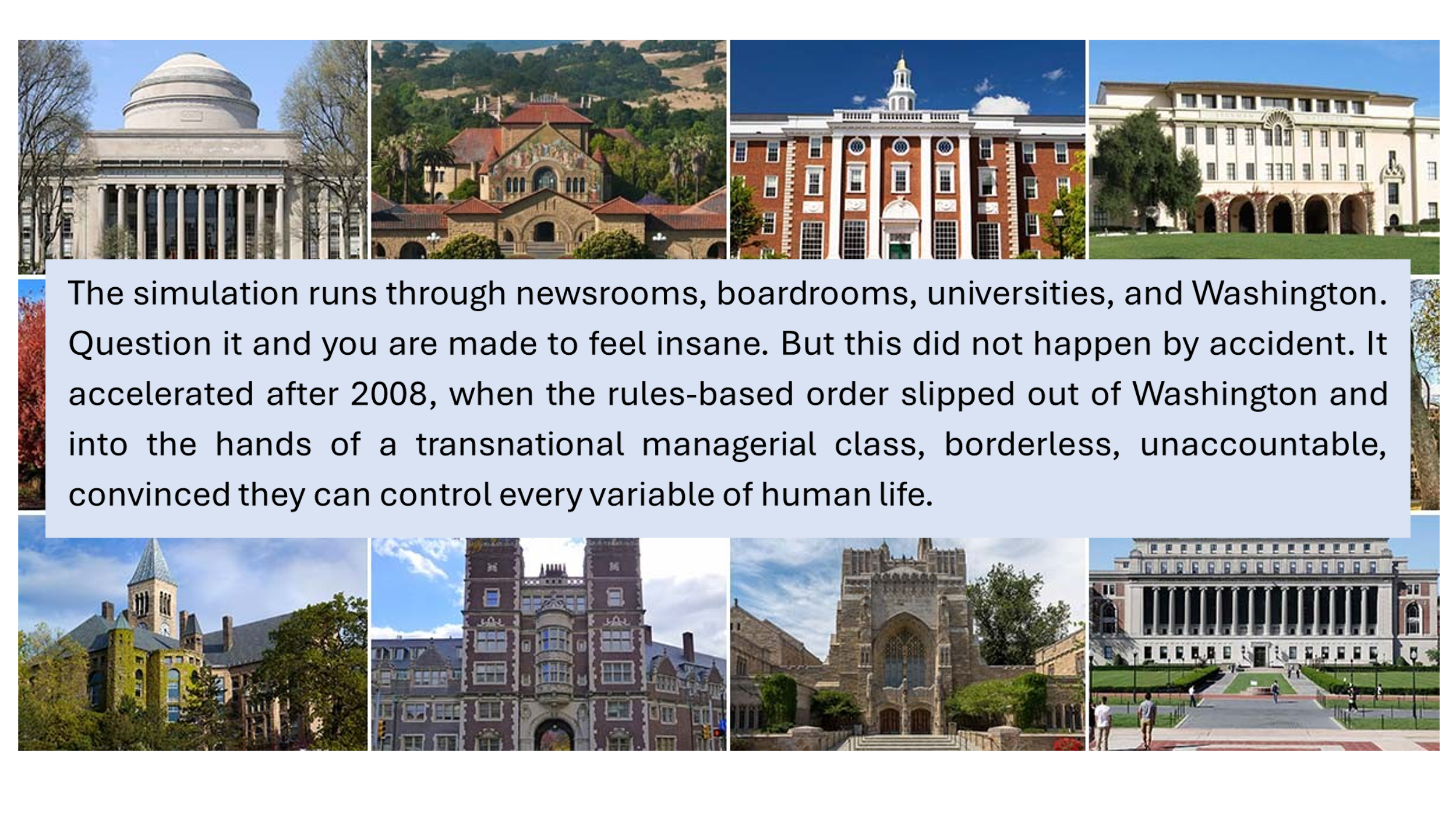
This does not begin with CNN or the New York Times or the rest of MSM. It does not begin with politicians. The “reality” we are fed is a top-down simulation: a second, artificial world built by elites who believe they can replace God, manage humanity, and rewrite existence itself. And once you see it, you cannot unsee it.
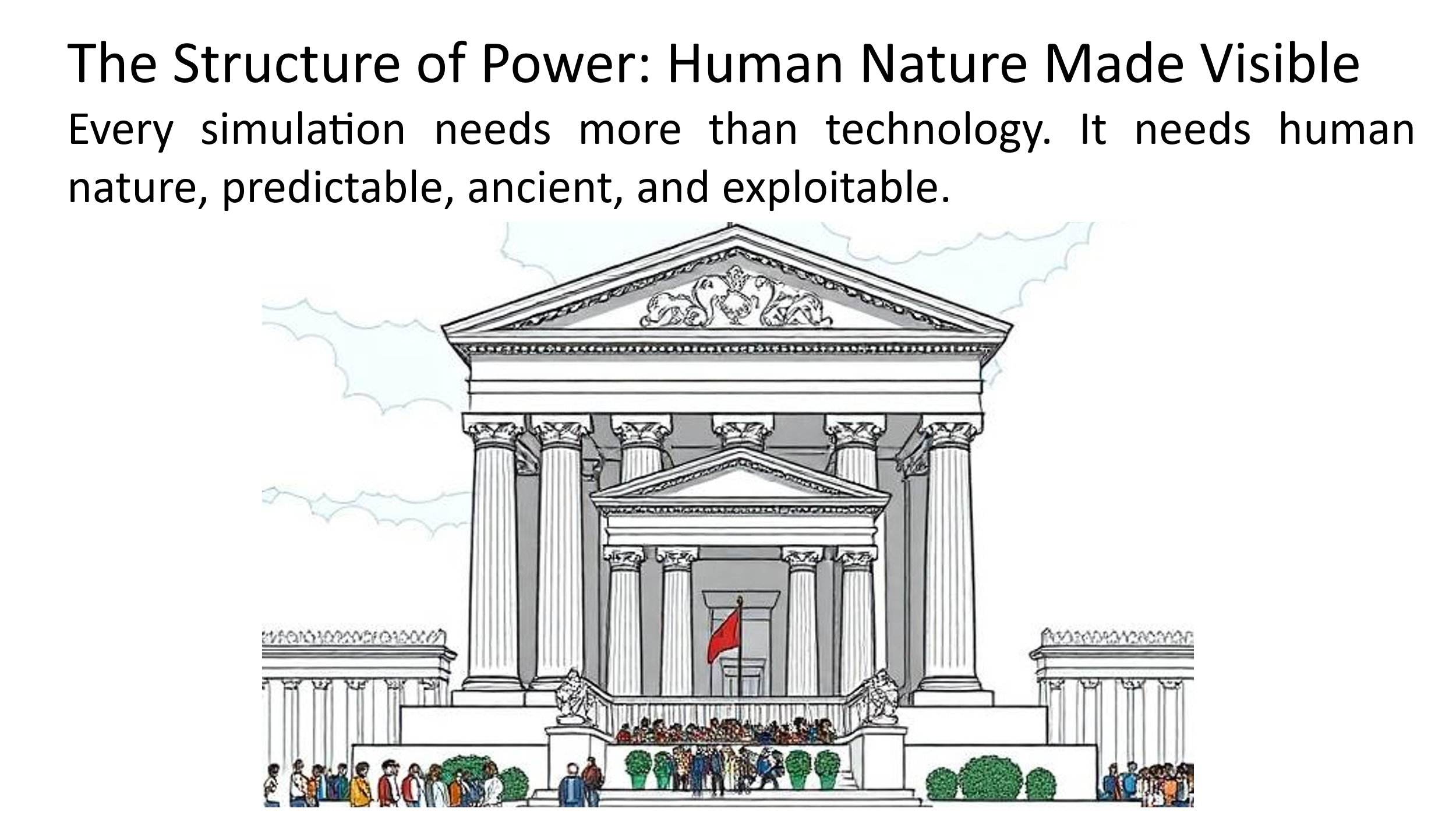
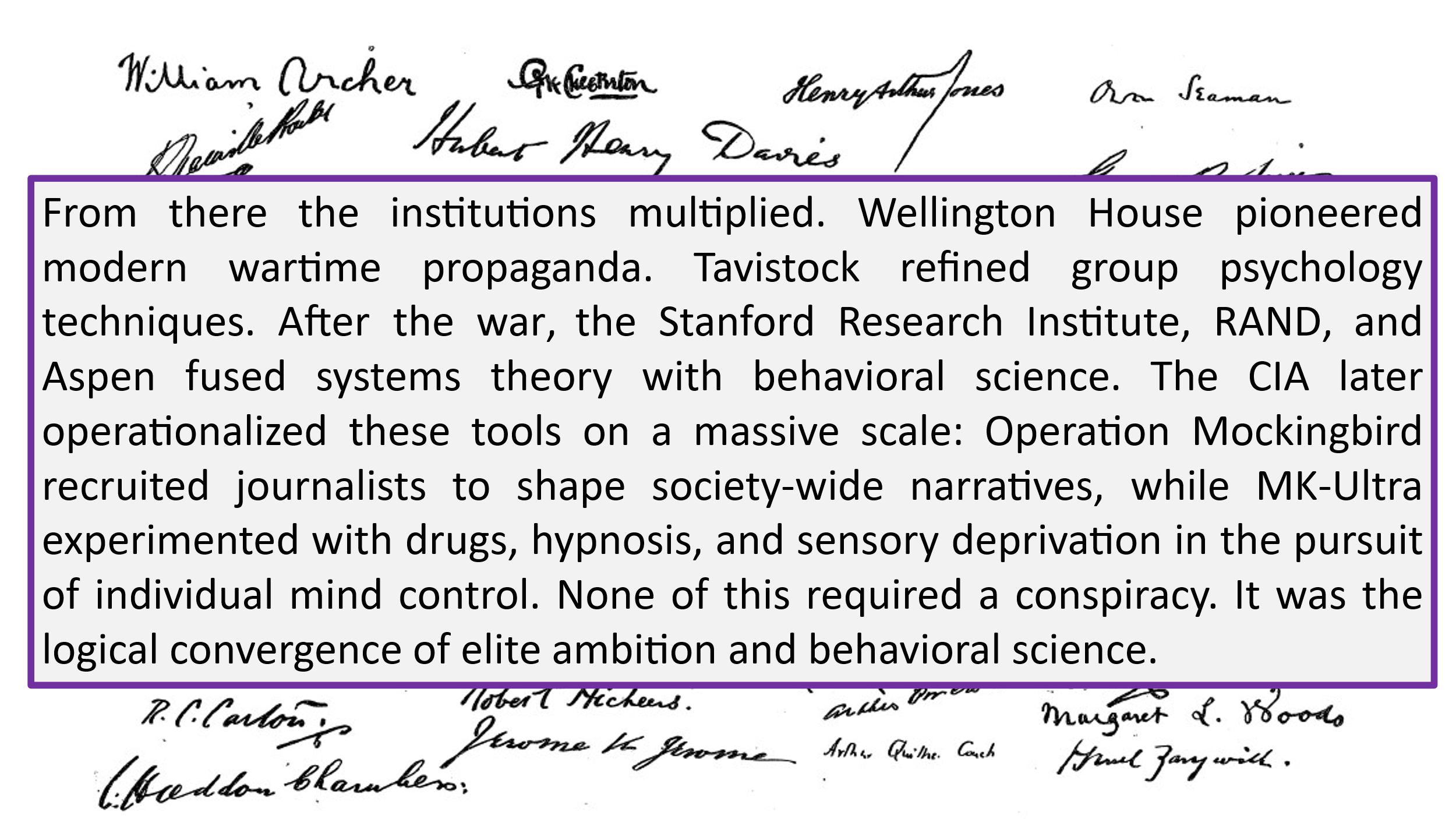
The real architects were the behavioral engineers of the early 20th century. Walter Lippmann argued in 1922 that the public was a “bewildered herd” incapable of self-governance and required a class of experts to manufacture the “pictures in our heads.”[3] Edward Bernays, Freud’s nephew, turned this insight into a science, openly calling for the “engineering of consent” through desire, fear, and subconscious manipulation[4].
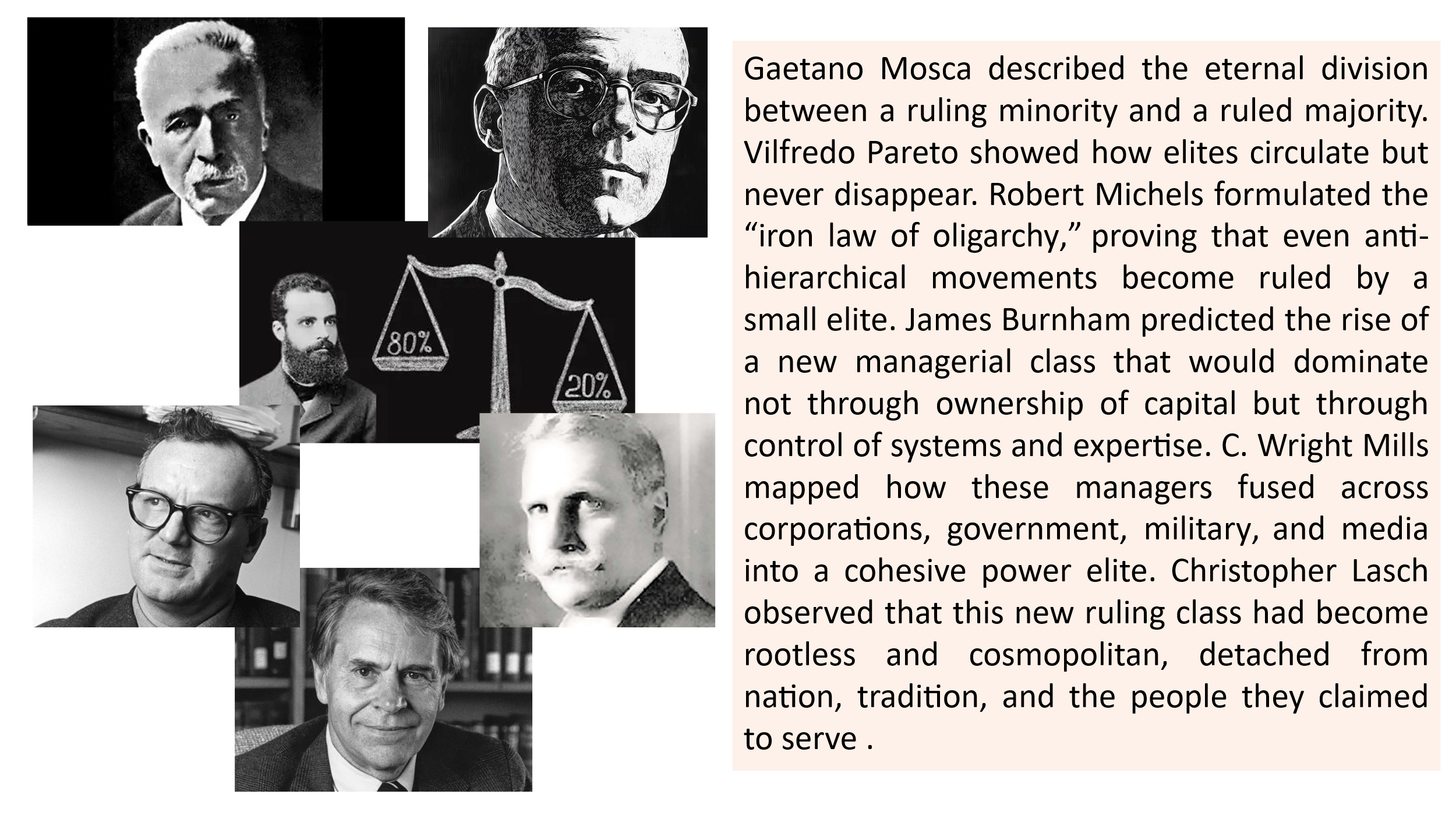
But if the behavioral engineers built the machinery, a separate lineage of thinkers revealed the underlying structure of power itself.
At the philosophical core stands Eric Voegelin. He diagnosed the deepest psychological driver: when elites lose contact with transcendent truth and objective reality, they construct an entirely new “second reality.”
This Gnostic impulse leads them to believe they possess secret knowledge that allows them to “immanentize the eschaton”, to drag heaven down to earth through technocratic management and replace the divine order with their own administered utopia.
This is the architecture of the simulation: a ruling minority (Mosca), circulating but aligned (Pareto), embedded in oligarchic institutions (Michels), governed by a managerial class (Burnham), fused across sectors (Mills), detached from the nation (Lasch), and living inside a curated second reality (Voegelin).
No conspiracy is required. Human nature is enough. These great minds did not develop the simulation, they simply explained why it was inevitable.
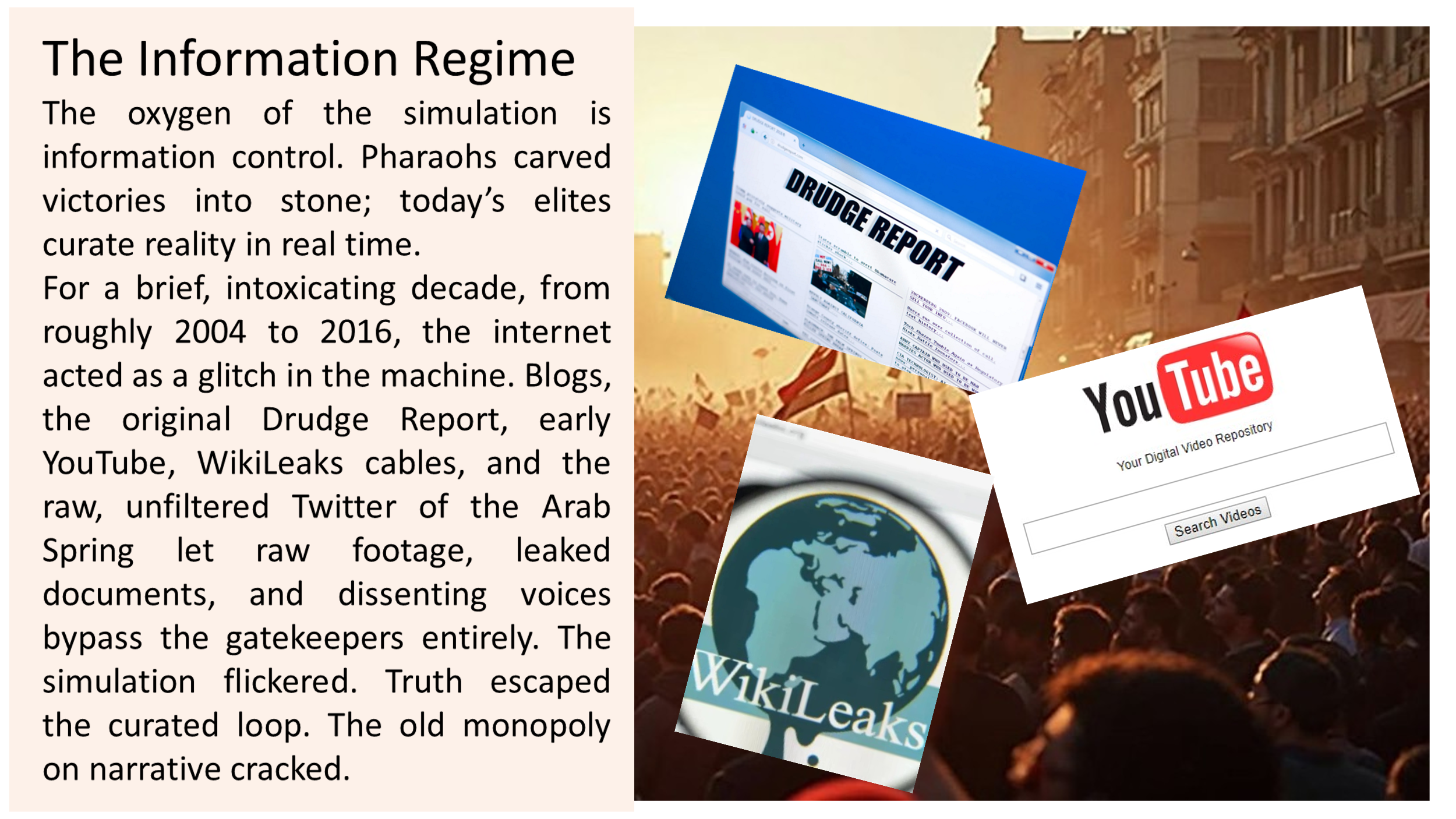
Then the counter-reformation arrived. After 2016 the platforms, now mature, advertising-driven, and terrified of regulators, flipped from neutral pipes to active curators. Algorithms replaced chronology, boosting “authoritative” sources and burying dissent.
Fact-checking consortiums, partnered with the very governments and NGOs they were meant to watch, became the new priesthood. Payment processors (Visa, Mastercard, Stripe, PayPal) learned they could starve heretical voices without firing a single journalist.
Deplatforming, shadow-banning, and demonetization did what old-school censorship never could: they made the alternatives invisible before most people even knew they existed. What began as a democratizing technology recentralized faster and more completely than any state censor could have dreamed.
The simulation didn’t just recover; it upgraded. The digital version is smoother, more personalized, and far harder to escape than the analog one ever was.
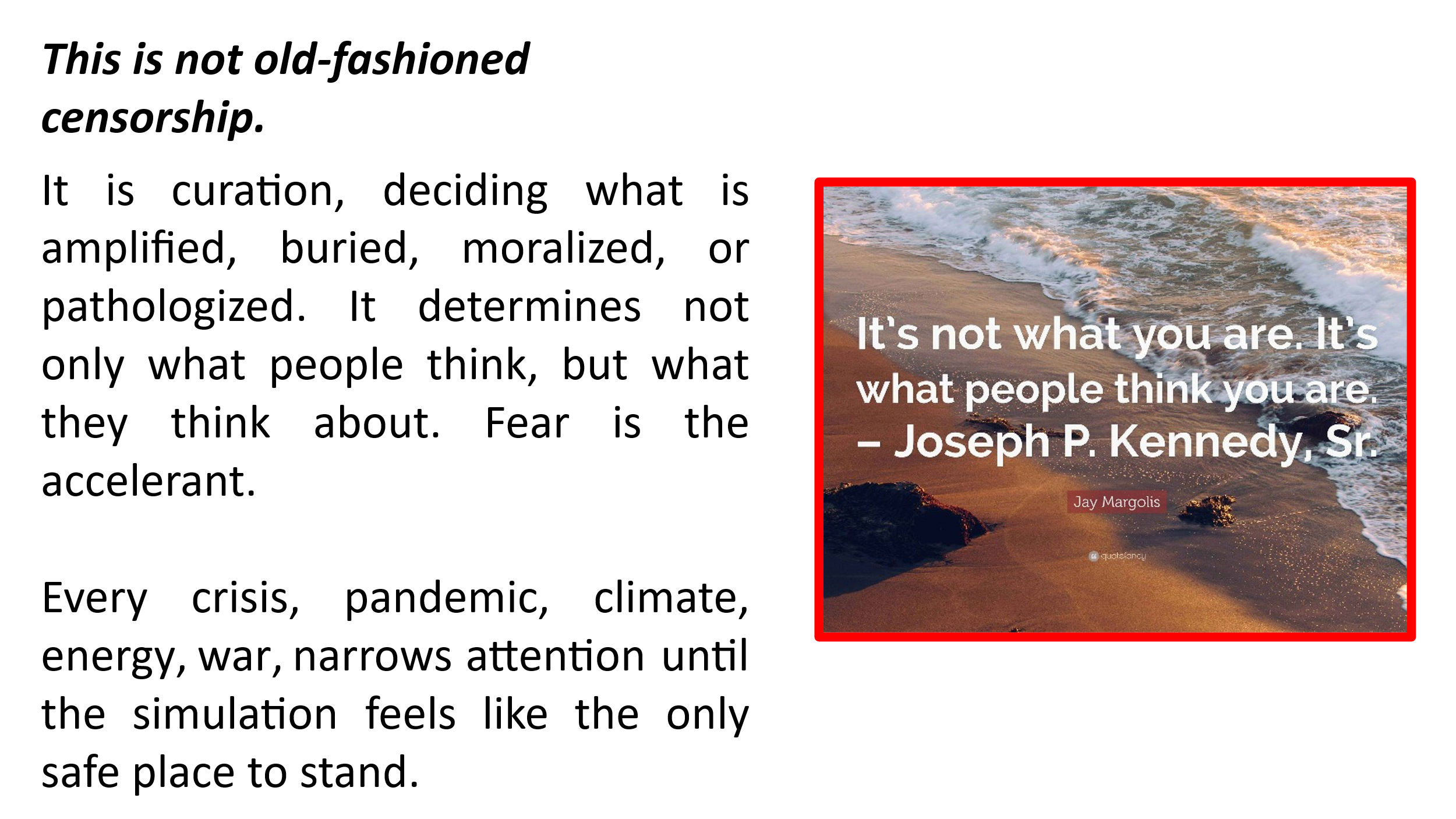
The result is a closed epistemic loop. Elites craft the story. Managers distribute it. Citizens enforce it socially. Alternatives become invisible, discredited, or dangerous. Dissent feels lonely because it is designed to. Yet the same technology that centralized control now also lets ordinary people glimpse behind the curtain. The battle for information is not a culture war. It is the war. Everything else is downstream.
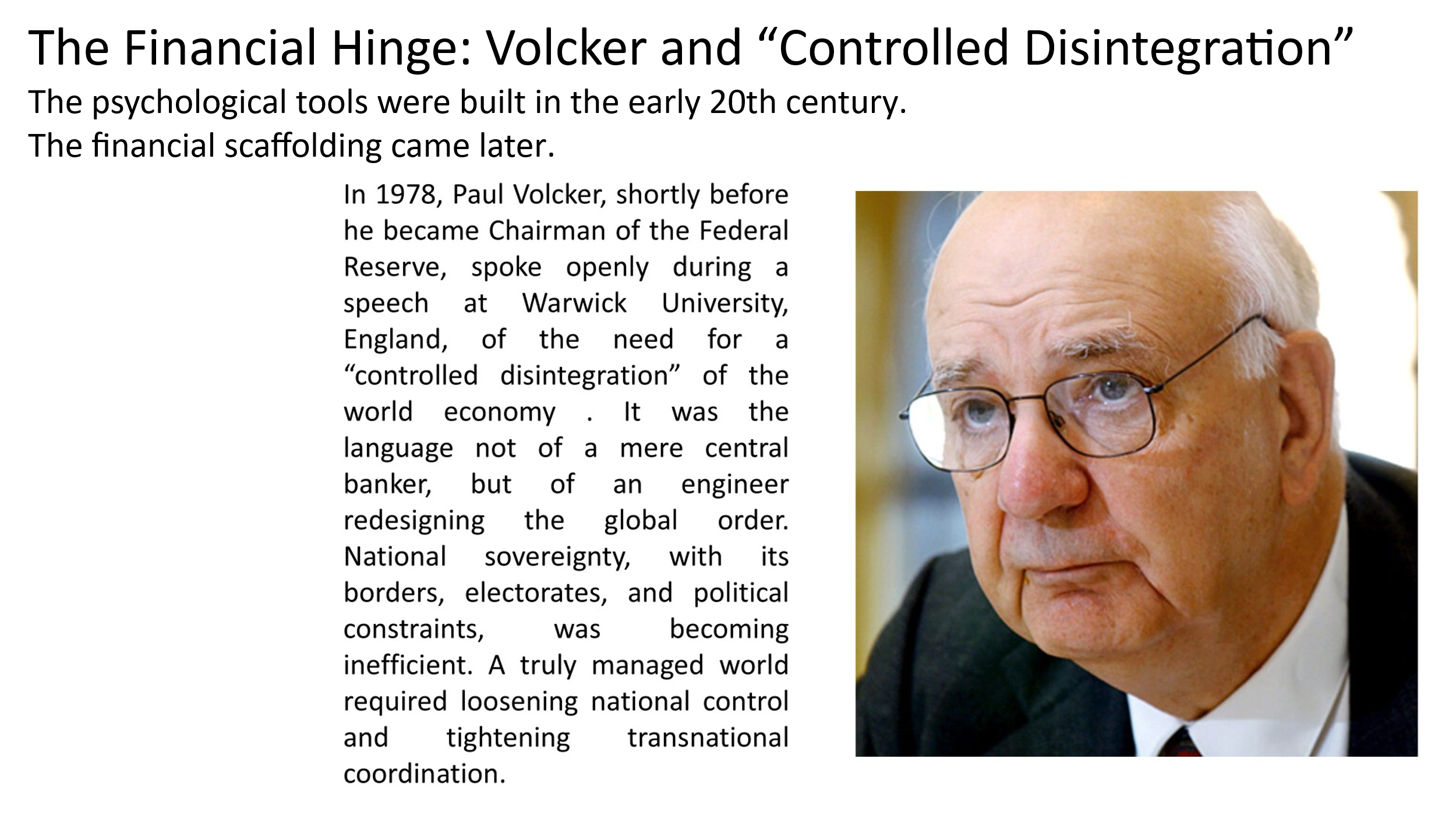
Volcker’s vision could not be implemented through policy alone. It required a moment when the old reality would lose legitimacy, when the public could be persuaded that national sovereignty was no longer capable of managing a world that had quietly outgrown it. And legitimacy rarely collapses through argument. It collapses when the existing order can no longer explain the world people are living in.
For decades, the financial system drifted toward that point: deeper integration, expanding derivatives markets, rising leverage, and institutions so interconnected that no one could map them. The architecture of a new order was already in place. What it needed was a crisis large enough to make the second reality feel inevitable.
All it needed was a catalyst.
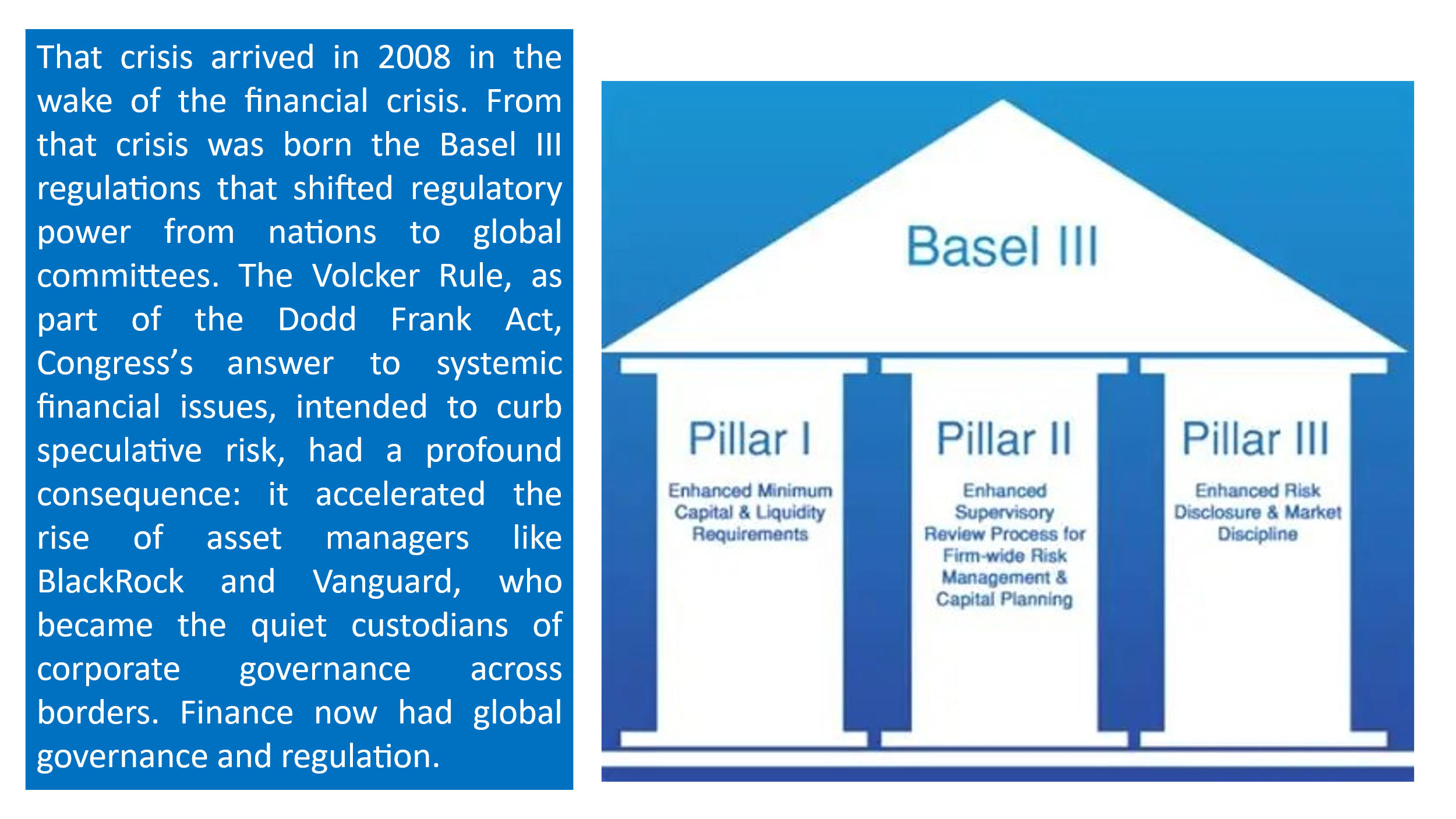
Power migrated upward, away from voters and toward a transnational managerial class that sees itself not as citizens of nations, but as stewards of a system. Volcker had predicted it. The disintegration of national sovereignty was not a crisis. It was a design and an opportunity.
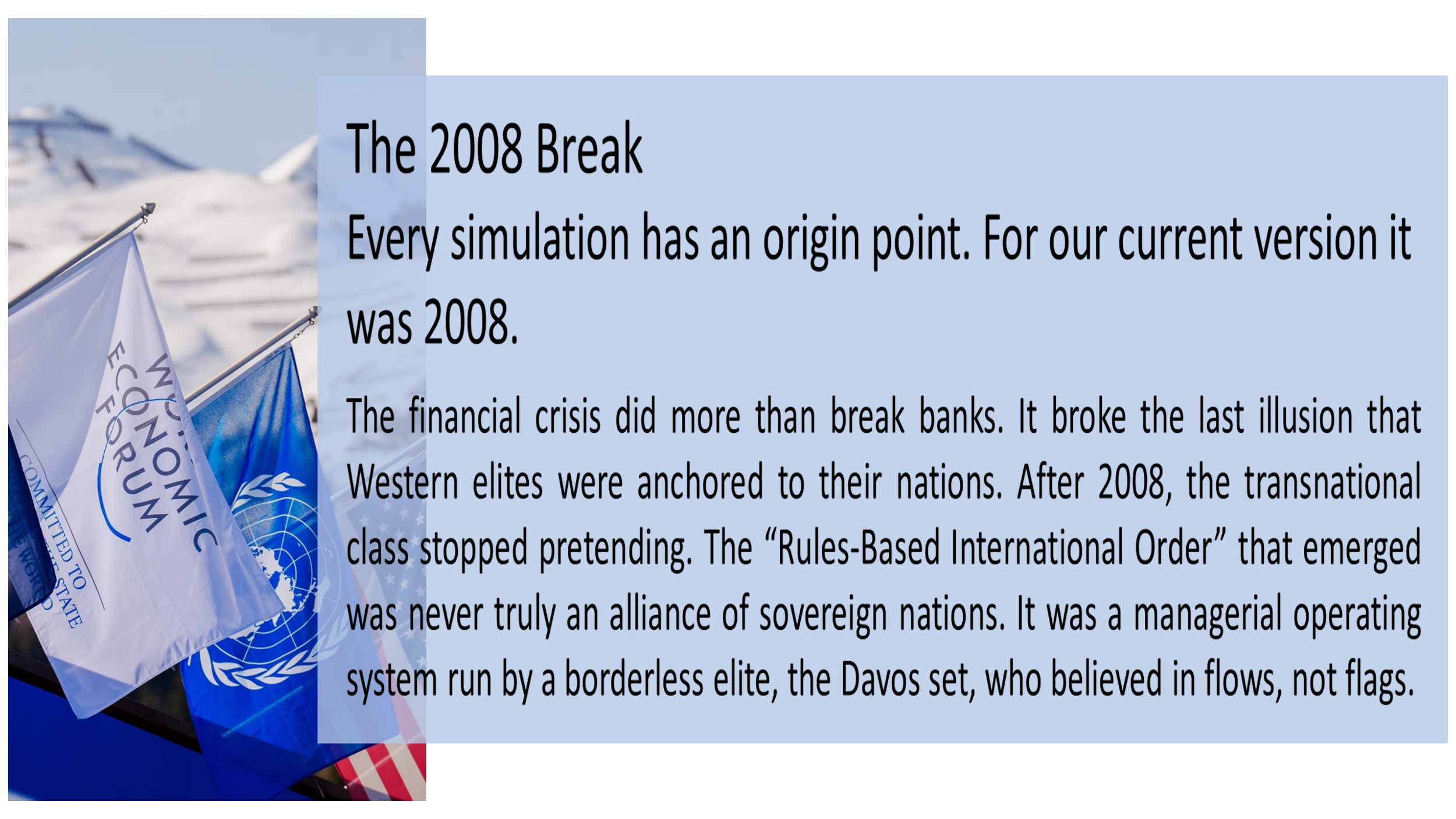
This explains why politics now feels performative. Elections rarely change outcomes. Identical policies appear in Washington, Brussels, Ottawa, Canberra, and Davos because the same class writes them. Burnham, Pareto, Michels, and Lasch all described this dynamic long before it had a name. The simulation was not born in 2008, but it was then it became global, digital, and self-aware.
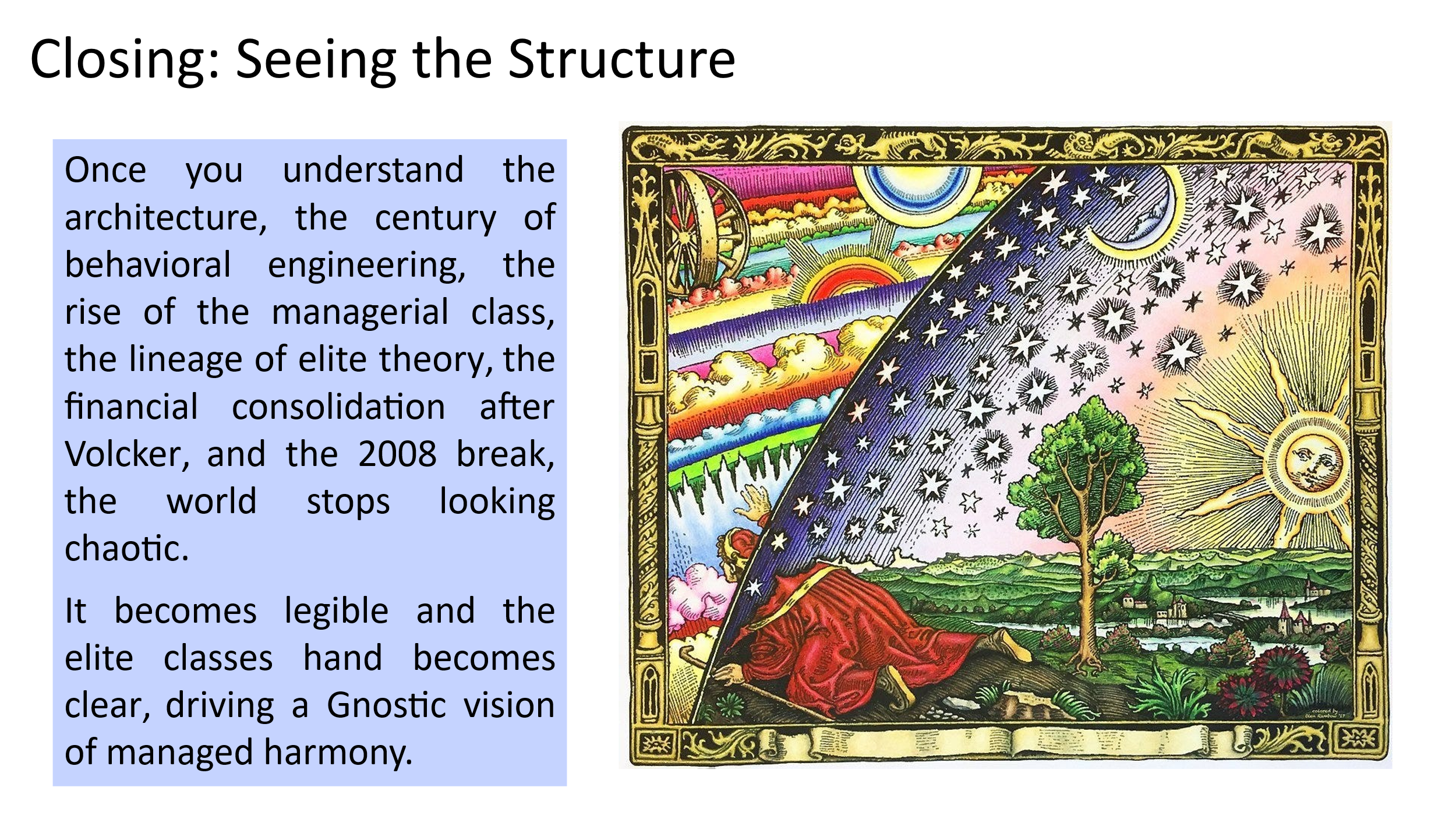
The simulation is not new, and it is not a conspiracy. It is the predictable outcome of human nature, institutional incentives, and elite psychology. It persists because it feels safer than reality and offers ready‑made virtue. But the moment you see the structure, you are no longer inside it.
Newsletter Two turns from architecture to operation, from the blueprint to the lived experience. It examines how the simulation behaves in real time, how it manufactures consent, weaponizes fear, handled COVID, frames war, and how ordinary people can break free of it.
support_us
Endnotes
- https://www.nytimes.com/2026/02/28/world/middleeast/ayatollah-ali-khamenei-dead.html ↑
- Eric Voegelin, The New Science of Politics (University of Chicago Press, 1952/1987 ed.), esp. chapters on Gnosticism and modern ideologies. Voegelin describes “second reality” as a constructed, closed worldview detached from transcendent truth, where ideologues substitute immanent (earthly) salvation for divine order. ↑
- Walter Lippmann, Public Opinion (Harcourt, Brace and Company, 1922), p. 127 and throughout. Lippmann describes the public as a “bewildered herd” needing elite guidance to form coherent “pictures in our heads” about distant events. ↑
- Edward Bernays, “The Engineering of Consent” (essay in The Annals of the American Academy of Political and Social Science, March 1947; expanded into book form, University of Oklahoma Press, 1955). Bernays, drawing on Freudian psychology, advocated scientific manipulation of public opinion for social ends. ↑